
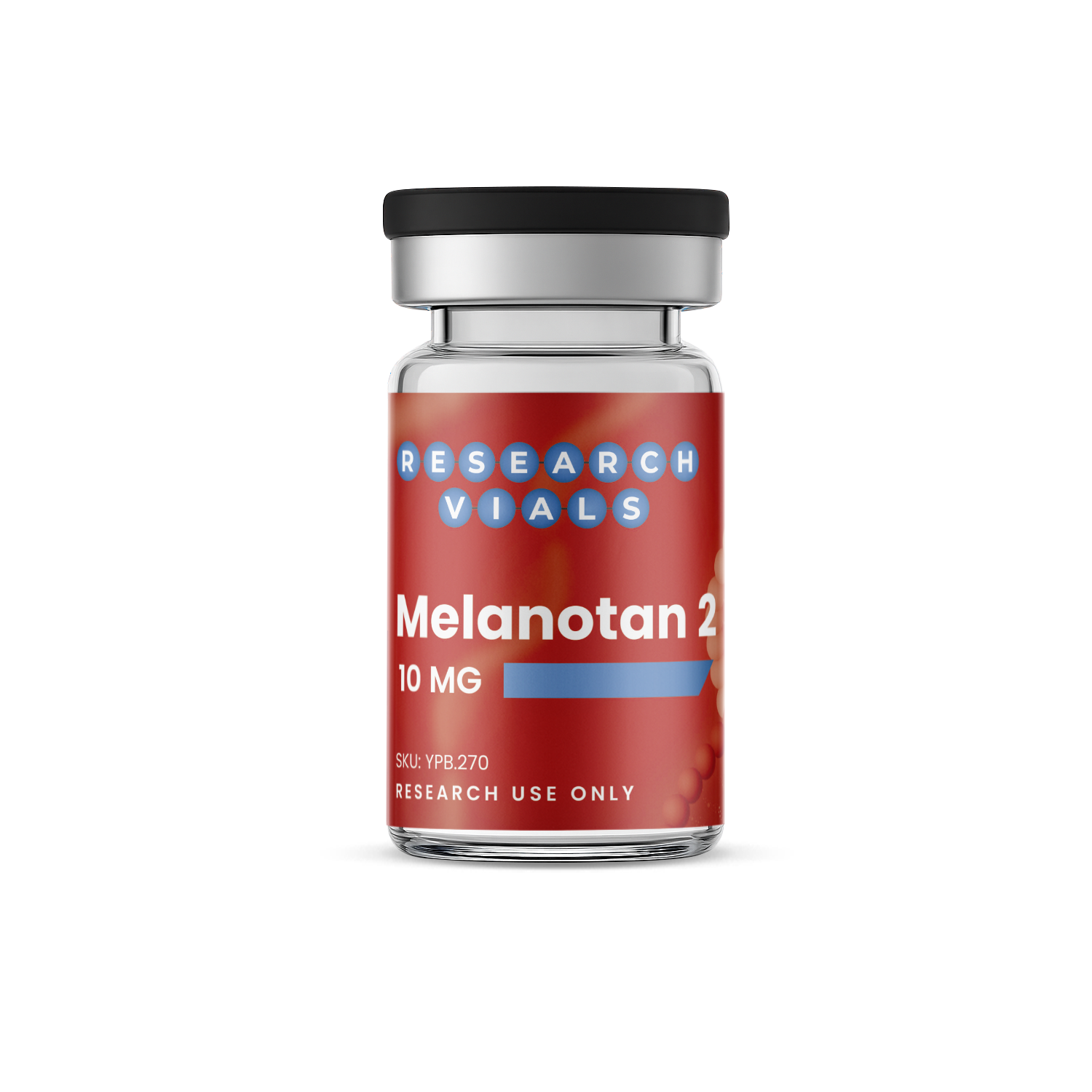
Melanotan 2 (10mg)
$29.75
Description
A single-component research material supplied for controlled research environments. Suitable for studies involving melanocortin receptor pathway characterization (e.g., MC1R/MC4R models) and method development in model systems.Not for human use.
Documentation & Quality Assurance
Each lot is sourced through our verified global supply chain with emphasis on traceability and quality control.These documents are reviewed internally and displayed as they become available. Independent third-party testing is also performed on select lots to confirm identity, purity, and alignment with our internal specifications.
Important Notice
This product is intended for laboratory research use only. It is not intended for human or veterinary use, and must not be used for diagnostic, therapeutic, or clinical purposes.
This material is not a drug, medical device, or dietary supplement, and has not been evaluated by the U.S. Food and Drug Administration.
Quality & Manufacturing
All materials are sourced from carefully vetted domestic and international manufacturing partners who follow quality systems consistent with ISO and cGMP principles. Each supplier is reviewed for reliability, documentation integrity, and transparency in testing.
We require a verified purity of 99% or higher and perform independent third-party spot testing to confirm that select lots meet our internal standards for identity, purity, and composition. Where available, endotoxin testing results are included on Certificates of Analysis to verify laboratory purity; their inclusion is for research quality assessment only and does not imply suitability for human or veterinary use.
All research materials are sealed for integrity and packaged for stability during storage and transport from manufacturing through final delivery.
Additional information
| Weight | 0.0625 lbs |
|---|
Certificate of Analysis
Every batch undergoes independent third-party laboratory analysis to verify identity, potency, and safety. Testing includes quantitative assay verification, heavy metals screening, and comprehensive microbial analysis.
View Certificate of AnalysisStorage Instructions
All products from Research Vials are manufactured using a lyophilization (freeze-drying) process. This method is designed to maintain product integrity and allows vials to remain stable during shipping for approximately 3–4 months.
Once a vial is reconstituted with bacteriostatic water, it should be stored in the refrigerator to help maintain stability. Under these conditions, reconstituted material is generally considered stable for up to 30 days.
Lyophilization is a dehydration technique in which compounds are frozen and then exposed to low pressure. This causes the water in the vial to sublimate directly from solid to gas, leaving behind a stable, crystalline white structure. This powder can be kept at room temperature until reconstitution.
Upon receipt, products should be stored away from heat and light. For short-term use, refrigeration at approximately 4°C (39°F) is suitable. For long-term storage (several months to years), vials may be placed in a freezer at approximately -80°C (-112°F). Freezing is the preferred method for preserving product stability over extended periods.
⚠️ Important Notice:
These products are intended for research use only. Not for human consumption.
Research Use Only
These studies reference research-grade peptides for laboratory and scientific investigation only. Not for human consumption. Not intended to diagnose, treat, cure, or prevent any disease.
Published Scientific Research
Peer-reviewed laboratory research investigating melanocortin receptor peptides from leading scientific databases
Structure elucidation of a human melanocortin-4 receptor specific orthosteric nanobody agonist.
The melanocortin receptor 4 (MC4R) belongs to the melanocortin receptor family of G-protein coupled receptors and is a key switch in the leptin-melanocortin molecular axis that controls hunger and satiety. Brain-produced hormones such as α-melanocyte-stimulating hormone (agonist) and agouti-related peptide (inverse agonist) regulate the molecular communication of the MC4R axis but are promiscuous for melanocortin receptor subtypes and induce a wide array of biological effects.
View Full StudyPrefrontal cortex melanocortin 4 receptors (MC4R) mediate food intake behavior in male mice.
BACKGROUND: Melanocortin 4 receptor (MC4R) activity in the hypothalamus is crucial for regulation of metabolism and food intake. The peptide ligands for the MC4R are associated with feeding, energy expenditure, and also with complex behaviors that orchestrate energy intake and expenditure, but the downstream neuroanatomical and neurochemical targets associated with these behaviors are elusive.
View Full StudySetmelanotide optimization through fragment-growing, molecular docking in-silico method targeting MC4 receptor.
Obesity has emerged as a global issue, but with the complex structures of multiple related important targets and their agonists or antagonists determined, the mechanism of ligand-protein interaction may offer new chances for developing new generation agonists anti-obesity. The simulation results indicate that the derivatives could improve the binding abilities with the melanocortin 4 receptor and the selectivity over the melanocortin 1 receptor.
View Full StudyDevelopment of Melanocortin 4 Receptor Agonists by Exploiting Animal-Derived Macrocyclic, Disulfide-Rich Peptide Scaffolds.
G protein-coupled receptors are among the most widely studied classes of drug targets. A major challenge in this field is to develop ligands that will selectively modulate a single receptor subtype to overcome the disadvantages of undesired "off target" effects caused by lack of target and thus signaling specificity.
View Full StudyDevelopmental programming of hypothalamic melanocortin circuits.
The melanocortin system plays a critical role in the central regulation of food intake and energy balance. This system consists of neurons producing pro-opiomelanocortin (POMC), melanocortin receptors (MC4Rs), and the endogenous antagonist agouti-related peptide (AgRP).
View Full StudyLigands for Melanocortin Receptors: Beyond Melanocyte-Stimulating Hormones and Adrenocorticotropin.
The discovery of melanocortins in 1916 has resulted in more than 100 years of research focused on these peptides. Extensive studies have elucidated well-established functions of melanocortins mediated by cell surface receptors, including MSHR (melanocyte-stimulating hormone receptor) and ACTHR (adrenocorticotropin receptor).
View Full StudyRelated products
-
NAD+
Price range: $48.95 through $79.95Select options This product has multiple variants. The options may be chosen on the product page -
-