
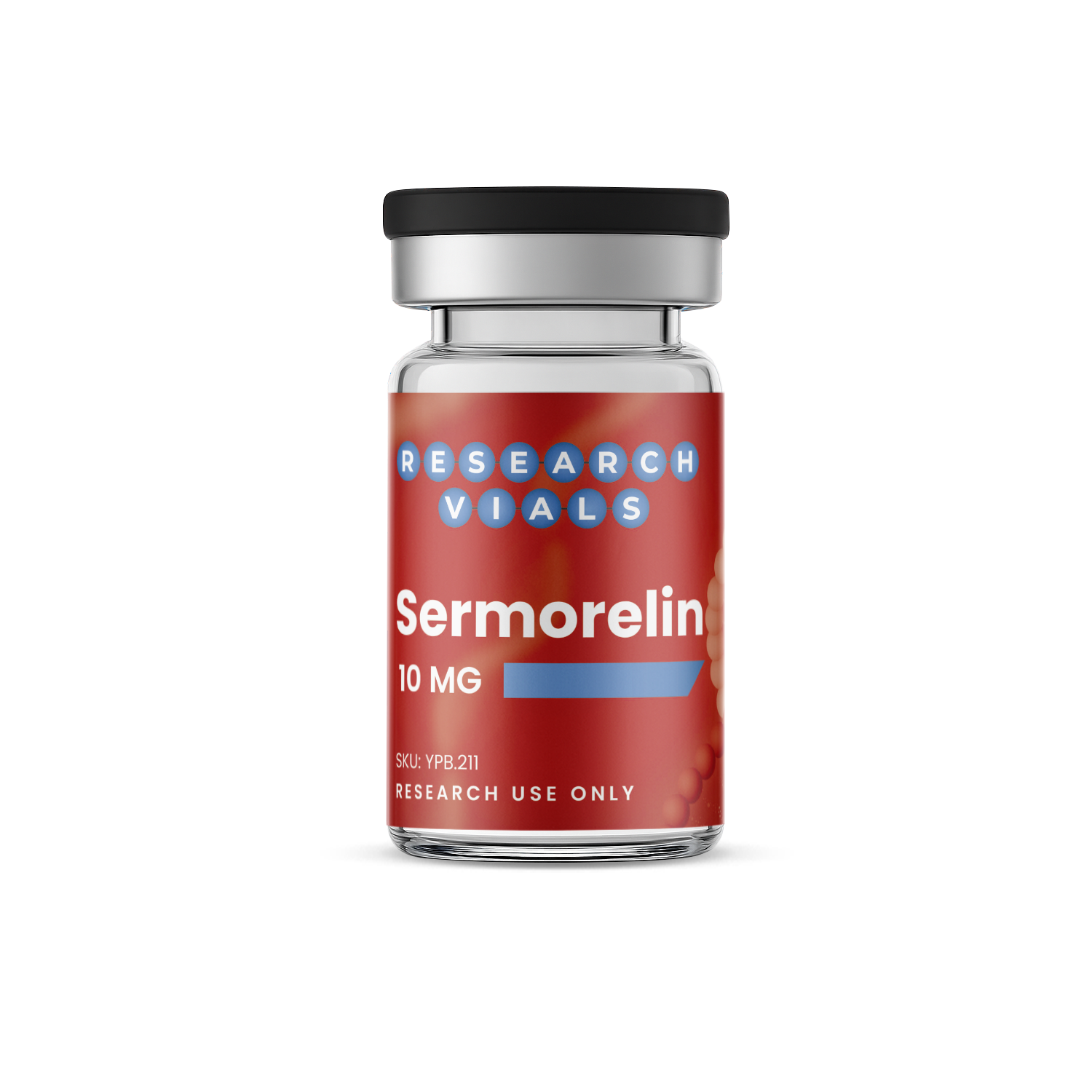
Sermorelin (10mg)
$59.99
Description
A single-component research material supplied for controlled research environments. Suitable for studies involving GHRH-receptor pathway characterization and method development in model systems.Not for human use.
Documentation & Quality Assurance
Each lot is sourced through our verified global supply chain with emphasis on traceability and quality control.These documents are reviewed internally and displayed as they become available. Independent third-party testing is also performed on select lots to confirm identity, purity, and alignment with our internal specifications.
Important Notice
This product is intended for laboratory research use only. It is not intended for human or veterinary use, and must not be used for diagnostic, therapeutic, or clinical purposes.
This material is not a drug, medical device, or dietary supplement, and has not been evaluated by the U.S. Food and Drug Administration.
Quality & Manufacturing
All materials are sourced from carefully vetted domestic and international manufacturing partners who follow quality systems consistent with ISO and cGMP principles. Each supplier is reviewed for reliability, documentation integrity, and transparency in testing.
We require a verified purity of 99% or higher and perform independent third-party spot testing to confirm that select lots meet our internal standards for identity, purity, and composition. Where available, endotoxin testing results are included on Certificates of Analysis to verify laboratory purity; their inclusion is for research quality assessment only and does not imply suitability for human or veterinary use.
All research materials are sealed for integrity and packaged for stability during storage and transport from manufacturing through final delivery.
Additional information
| Weight | 0.0625 lbs |
|---|
Certificate of Analysis
Every batch undergoes independent third-party laboratory analysis to verify identity, potency, and safety. Testing includes quantitative assay verification, heavy metals screening, and comprehensive microbial analysis.
View Certificate of AnalysisStorage Instructions
All products from Research Vials are manufactured using a lyophilization (freeze-drying) process. This method is designed to maintain product integrity and allows vials to remain stable during shipping for approximately 3–4 months.
Once a vial is reconstituted with bacteriostatic water, it should be stored in the refrigerator to help maintain stability. Under these conditions, reconstituted material is generally considered stable for up to 30 days.
Lyophilization is a dehydration technique in which compounds are frozen and then exposed to low pressure. This causes the water in the vial to sublimate directly from solid to gas, leaving behind a stable, crystalline white structure. This powder can be kept at room temperature until reconstitution.
Upon receipt, products should be stored away from heat and light. For short-term use, refrigeration at approximately 4°C (39°F) is suitable. For long-term storage (several months to years), vials may be placed in a freezer at approximately -80°C (-112°F). Freezing is the preferred method for preserving product stability over extended periods.
⚠️ Important Notice:
These products are intended for research use only. Not for human consumption.
Research Use Only
These studies reference research-grade peptides for laboratory and scientific investigation only. Not for human consumption. Not intended to diagnose, treat, cure, or prevent any disease.
Published Scientific Research
Peer-reviewed laboratory research investigating growth hormone peptides from leading scientific databases
Exploring the role of GHRH antagonist MIA-602 in overcoming Doxorubicin-resistance in acute myeloid leukemia.
Notably, growth hormone-releasing hormone (GHRH) receptor antagonist MIA-602 has been shown to impede the growth of various human cancer cell lines, including AML.
View Full StudyGrowth hormone-releasing hormone antagonist MIA-602 inhibits inflammation induced by SARS-CoV-2 spike protein and bacterial lipopolysaccharide synergism in macrophages and human peripheral blood mononuclear cells.
Western blot and immunofluorescence analysis revealed the presence of GHRH receptor and its splice variant SV1 in both THP-1 cells and PBMCs. Mechanistically, MIA-602 blunted the S protein and LPS-induced activation of inflammatory pathways in THP-1 cells, such as NF-κB, STAT3, MAPK ERK1/2 and JNK.
View Full StudyImpact of growth hormone-releasing hormone antagonist on decidual stromal cell growth and apoptosis in vitro†.
Growth hormone-releasing hormone and its functional receptor have been shown to be expressed in gynecological cancer cells and eutopic endometrial stromal cells. The aim of this study was to investigate the effect of a growth hormone-releasing hormone antagonist (JMR-132) on cell proliferation and apoptosis of human decidual stromal cells and the underlying molecular mechanisms.
View Full StudySynthesis of potent antagonists of receptors for growth hormone-releasing hormone with antitumor and anti-inflammatory activity.
Five of nineteen tested AVR analogs presented binding affinities to the membrane GHRH receptors on human pituitary, 2-4-fold better than MIA-602. In vitro AVR analogs showed inhibition of cell viability equal to or greater than MIA-602.
View Full StudyInhibition of experimental small-cell and non-small-cell lung cancers by novel antagonists of growth hormone-releasing hormone.
Western blot and qRT-PCR analyses demonstrated a downregulation of expression of the pituitary-type GHRH-R and its splice-variant, cyclinD1/2, cyclin-dependent kinase4/6, p21-activated kinase-1, phosphorylation of activator of transcription 3 and cAMP response element binding protein; and an upregulation of expression of E-cadherin, β-catenin and P27 in cancer cells and in xenografted tumor tissues. The study demonstrates the involvement of GHRH antagonists in multiple signaling pathways in lung cancers.
View Full StudyGrowth hormone-releasing hormone receptor antagonists modify molecular machinery in the progression of prostate cancer.
To evaluate the effects of the new growth hormone-releasing hormone receptor (GHRH-R) antagonists: MIA-602, MIA-606, and MIA-690 on processes associated with cancer progression as cell proliferation, adhesion, migration, and angiogenesis. We analyzed several molecules such as E-cadherin, β-catenin, Bcl2, Bax, p53, MMP2, MMP9, PCNA, and VEGF and signaling mechanisms that are involved on effects exerted by GHRH-R antagonists.
View Full StudyRelated products
-
-
GLP-3 RT
Price range: $89.50 through $195.00Select options This product has multiple variants. The options may be chosen on the product page -