

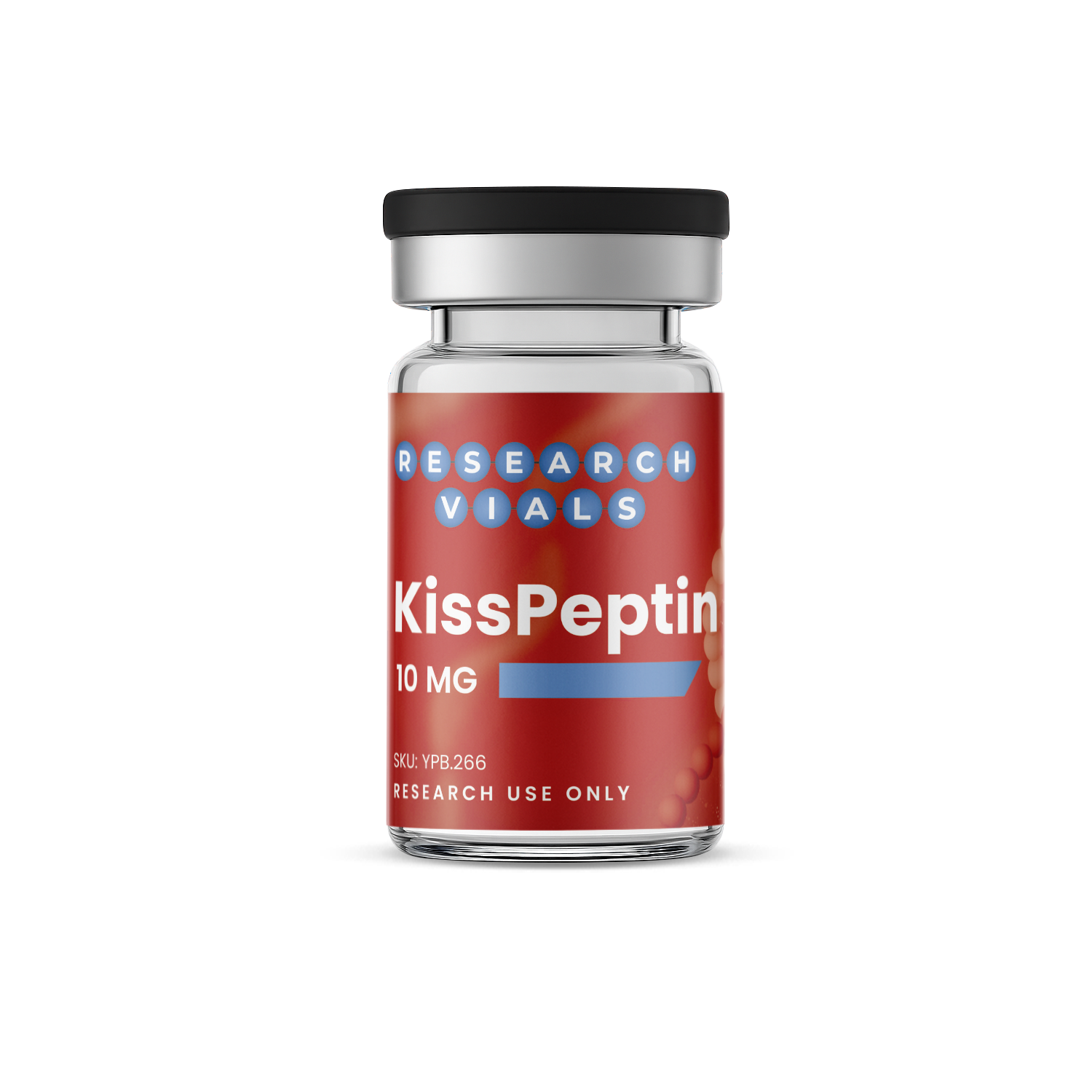
KissPeptin (10mg)
$39.50
Description
KissPeptin is a single-component research material supplied for controlled research environments. KissPeptin-10 (10 mg) is a synthetic decapeptide used in advanced research examining reproductive hormone signaling, hypothalamic-pituitary-gonadal (HPG) axis regulation, and neuroendocrine pathway characterization in model systems.
Composition
• KissPeptin
• Appearance:
Documentation & Quality Assurance
Each lot is sourced through our verified global supply chain with emphasis on traceability and quality control.These documents are reviewed internally and displayed as they become available. Independent third-party testing is also performed on select lots to confirm identity, purity, and alignment with our internal specifications.
Important Notice
This product is intended for laboratory research use only. It is not intended for human or veterinary use, and must not be used for diagnostic, therapeutic, or clinical purposes.
This material is not a drug, medical device, or dietary supplement, and has not been evaluated by the U.S. Food and Drug Administration.
Quality & Manufacturing
All materials are sourced from carefully vetted domestic and international manufacturing partners who follow quality systems consistent with ISO and cGMP principles. Each supplier is reviewed for reliability, documentation integrity, and transparency in testing.
We require a verified purity of 99% or higher and perform independent third-party spot testing to confirm that select lots meet our internal standards for identity, purity, and composition. Where available, endotoxin testing results are included on Certificates of Analysis to verify laboratory purity; their inclusion is for research quality assessment only and does not imply suitability for human or veterinary use.
All research materials are sealed for integrity and packaged for stability during storage and transport from manufacturing through final delivery.
Additional information
| Weight | 0.0625 lbs |
|---|
Certificate of Analysis
Every batch undergoes independent third-party laboratory analysis to verify identity, potency, and safety. Testing includes quantitative assay verification, heavy metals screening, and comprehensive microbial analysis.
View Certificate of AnalysisStorage Instructions
All products from Research Vials are manufactured using a lyophilization (freeze-drying) process. This method is designed to maintain product integrity and allows vials to remain stable during shipping for approximately 3–4 months.
Once a vial is reconstituted with bacteriostatic water, it should be stored in the refrigerator to help maintain stability. Under these conditions, reconstituted material is generally considered stable for up to 30 days.
Lyophilization is a dehydration technique in which compounds are frozen and then exposed to low pressure. This causes the water in the vial to sublimate directly from solid to gas, leaving behind a stable, crystalline white structure. This powder can be kept at room temperature until reconstitution.
Upon receipt, products should be stored away from heat and light. For short-term use, refrigeration at approximately 4°C (39°F) is suitable. For long-term storage (several months to years), vials may be placed in a freezer at approximately -80°C (-112°F). Freezing is the preferred method for preserving product stability over extended periods.
⚠️ Important Notice:
These products are intended for research use only. Not for human consumption.
Research Use Only
These studies reference research-grade peptides for laboratory and scientific investigation only. Not for human consumption. Not intended to diagnose, treat, cure, or prevent any disease.
Published Scientific Research
Peer-reviewed laboratory research investigating research peptides from leading scientific databases
Serum kisspeptin levels in women with polycystic ovary syndrome: A systematic review and meta-analysis.
INTRODUCTION: Kisspeptin is a key regulator of the hypothalamic-pituitary-gonadal axis and has been implicated in the pathophysiology of polycystic ovary syndrome (PCOS). However, reported associations between kisspeptin levels and PCOS have been inconsistent. MATERIALS AND METHODS: A systematic search of PubMed, Scopus, and Web of Science was performed from inception to August 2025 for studies comparing serum kisspeptin concentrations between PCOS patients and controls. Data extraction was cond
View Full StudyKisspeptin and early pregnancy: Insights from animal models into hormonal regulation and miscarriage.
Implantation failure and early placental dysfunction are major contributors, yet the precise mechanisms remain incompletely understood. Human studies indicate that reduced placental kisspeptin is associated with recurrent pregnancy loss, while circulating kisspeptin levels increase dramatically throughout gestation and may serve as a biomarker for pregnancy viability.
View Full StudyKisspeptin and neurokinin B: roles in reproductive health.
Over the last two decades, research findings have considerably enhanced our understanding of the physiological regulation of the hypothalamic-pituitary-gonadal (HPG) axis and identified potential therapeutic applications. Moreover, the key role of NKB in the pathophysiology of menopausal hot flashes has led to the development of pharmacological antagonism of this pathway.
View Full StudyOptogenetics studies of kisspeptin neurons.
Optical systems and genetic engineering technologies have made it possible to control neurons and unravel neuronal circuit behavior with high temporal and spatial resolution. The application of optogenetic strategies to understand the physiology of kisspeptin neuronal circuits has evolved in recent years among the neuroendocrine community. Kisspeptin neurons are fundamentally involved in controlling mammalian reproduction but also are implicated in numerous other physiological processes, includi
View Full StudyNovel therapeutic avenues for kisspeptin.
Finally, kisspeptin analogues could potentially overcome some of the pharmacological challenges associated with the natural forms of kisspeptin such as short duration of action and development of tachyphylaxis.
View Full StudyMathematical models in GnRH research.
Indeed, over the last 20 years mathematical modelling has been used to describe and explore the physiology of the GnRH neuron, the mechanisms underlying GnRH pulsatile secretion, and GnRH signalling to the pituitary.
View Full StudyRelated products
-
GLP-2 TZ
Price range: $59.00 through $189.90Select options This product has multiple variants. The options may be chosen on the product page -
-

Wolverine Blend – BPC-157 (5mg) / TB500 (5mg) (Globally Sourced)
Price range: $56.00 through $90.00Select options This product has multiple variants. The options may be chosen on the product page