
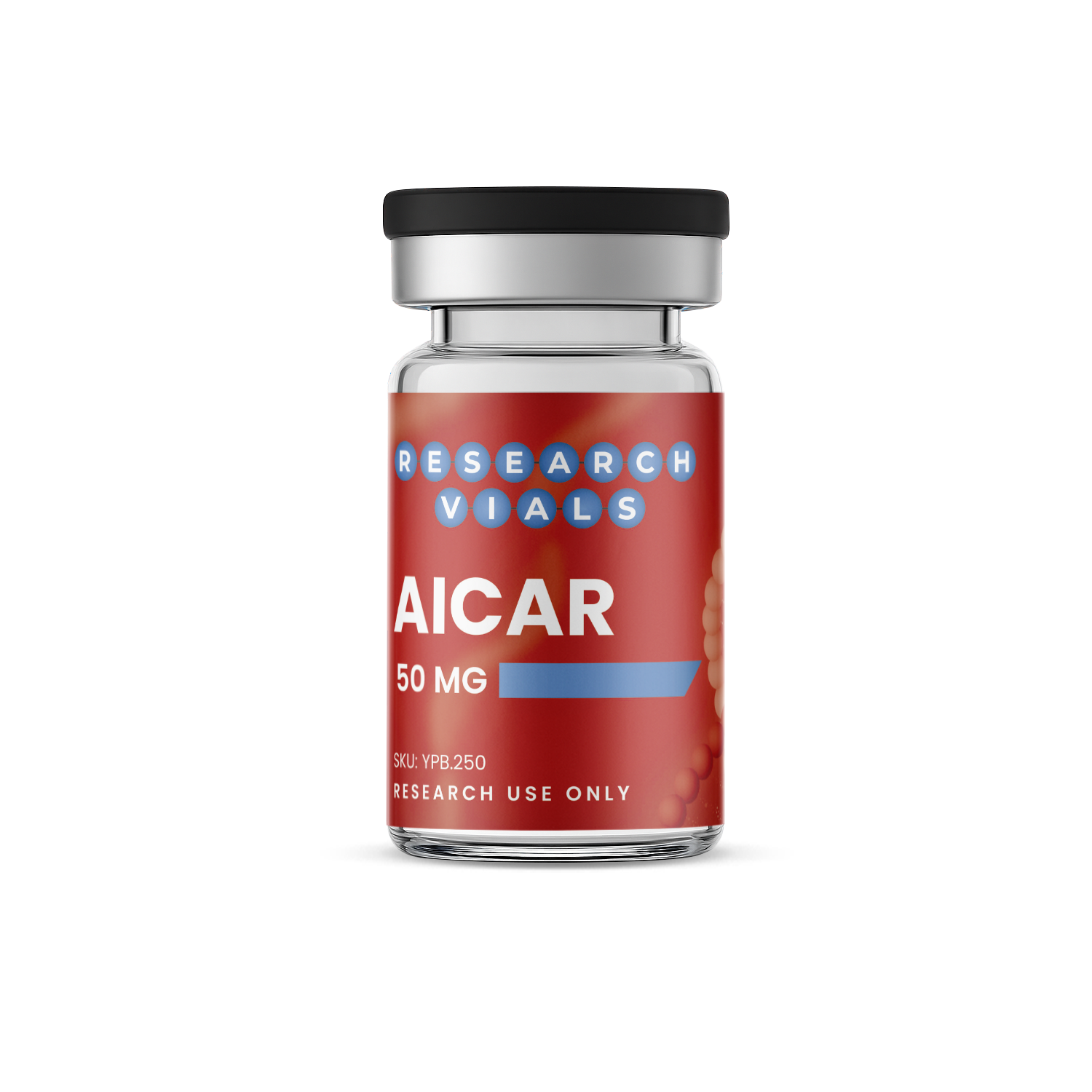
AICAR (50mg)
$130.00
Additional information
| Weight | 0.0625 lbs |
|---|
Storage Instructions
All products from Research Vials are manufactured using a lyophilization (freeze-drying) process. This method is designed to maintain product integrity and allows vials to remain stable during shipping for approximately 3–4 months.
Once a vial is reconstituted with bacteriostatic water, it should be stored in the refrigerator to help maintain stability. Under these conditions, reconstituted material is generally considered stable for up to 30 days.
Lyophilization is a dehydration technique in which compounds are frozen and then exposed to low pressure. This causes the water in the vial to sublimate directly from solid to gas, leaving behind a stable, crystalline white structure. This powder can be kept at room temperature until reconstitution.
Upon receipt, products should be stored away from heat and light. For short-term use, refrigeration at approximately 4°C (39°F) is suitable. For long-term storage (several months to years), vials may be placed in a freezer at approximately -80°C (-112°F). Freezing is the preferred method for preserving product stability over extended periods.
⚠️ Important Notice:
These products are intended for research use only. Not for human consumption.
Research Use Only
These studies reference research-grade peptides for laboratory and scientific investigation only. Not for human consumption. Not intended to diagnose, treat, cure, or prevent any disease.
Published Scientific Research
Peer-reviewed laboratory research investigating research peptides from leading scientific databases
CD137L promotes immune surveillance in melanoma via HLTF regulation.
Immune checkpoint blockers (ICBs) have demonstrated substantial efficacy across various malignancies, yet the benefits of ICBs are limited to a subset of patients. Therefore, it is essential to identify novel therapeutic targets. By integrating multi-omics data from cohorts of patients with melanoma treated with ICBs, a positive correlation is observed between tumor CD137L expression and the efficacy of PD-1 blockade. Functionally, CD137L induction in cancer cells significantly enhances anti-tum
View Full StudyResistance exercise upregulates Irisin expression and suppresses myocardial fibrosis following myocardial infarction via activating AMPK-Sirt1 and inactivating TGFβ1-Smad2/3.
RESULTS: Resistance exercise increased Fndc5 mRNA level, inhibited the activation of TGFβ1-TGFβR2-Smad2/3 pathway, activated AMPK-Sirt1 pathway, reduced the levels of oxidative stress, apoptosis, and MF in the infarcted heart, and promoted cardiac function. Results of the in vitro experiments showed that AICAR and rhIRISIN intervention activated the AMPK-Sirt1 pathway and inactivated the TGFβ1-Smad2/3 pathway, and promoted apoptosis in HO-treated CFs.
View Full StudyMitochondria-derived peptide MOTS-c: effects and mechanisms related to stress, metabolism and aging.
MOTS-c mainly acts through the Folate-AICAR-AMPK pathway, thereby influencing energy metabolism, insulin resistance, inflammatory response, exercise, aging and aging-related pathologies. This review summarizes the retrograde signaling of MOTS-c toward the nucleus, the regulation of energy metabolism, stress homeostasis, and aging-related pathological processes, as well as the underlying molecular mechanisms.
View Full StudyGDF15 in Appetite and Exercise: Essential Player or Coincidental Bystander?
When administered pharmacologically, GDF15 reduces food intake and lowers body weight via the hindbrain-situated receptor GFRAL (glial cell-derived neurotrophic factor family receptor alpha-like). In this review, we discuss the putative physiological implication of exercise-induced GDF15, focusing on the potential impact on appetite and metabolism.
View Full StudyAICAR attenuates postoperative abdominal adhesion formation by inhibiting oxidative stress and promoting mesothelial cell repair.
5-aminoimidazole-4-carboxyamide ribonucleoside (AICAR) is an adenosine 5'-monophosphate activated protein kinase (AMPK) pathway agonist that inhibits inflammation, reduces cell fibrosis and cellular reactive oxygen species (ROS) injury, promotes autophagy and mitochondrial function. This study aimed to explore the mechanism of AICAR in inhibiting adhesion formation.
View Full StudyDownregulation of AMPK dependent FOXO3 and TFEB involves in the inhibition of autophagy in diabetic cataract.
Notably, this down-regulation of autophagy activity was rescued by AICAR in vitro, which was manifested by inhibition of AKT and mTOR phosphorylation and up-regulation of FOXO3, TFEB, Beclin1 and LC3B-II expression. Thus, targeting AMPK-induced autophagy may be a potential therapeutic approach for diabetic cataract.
View Full Study