
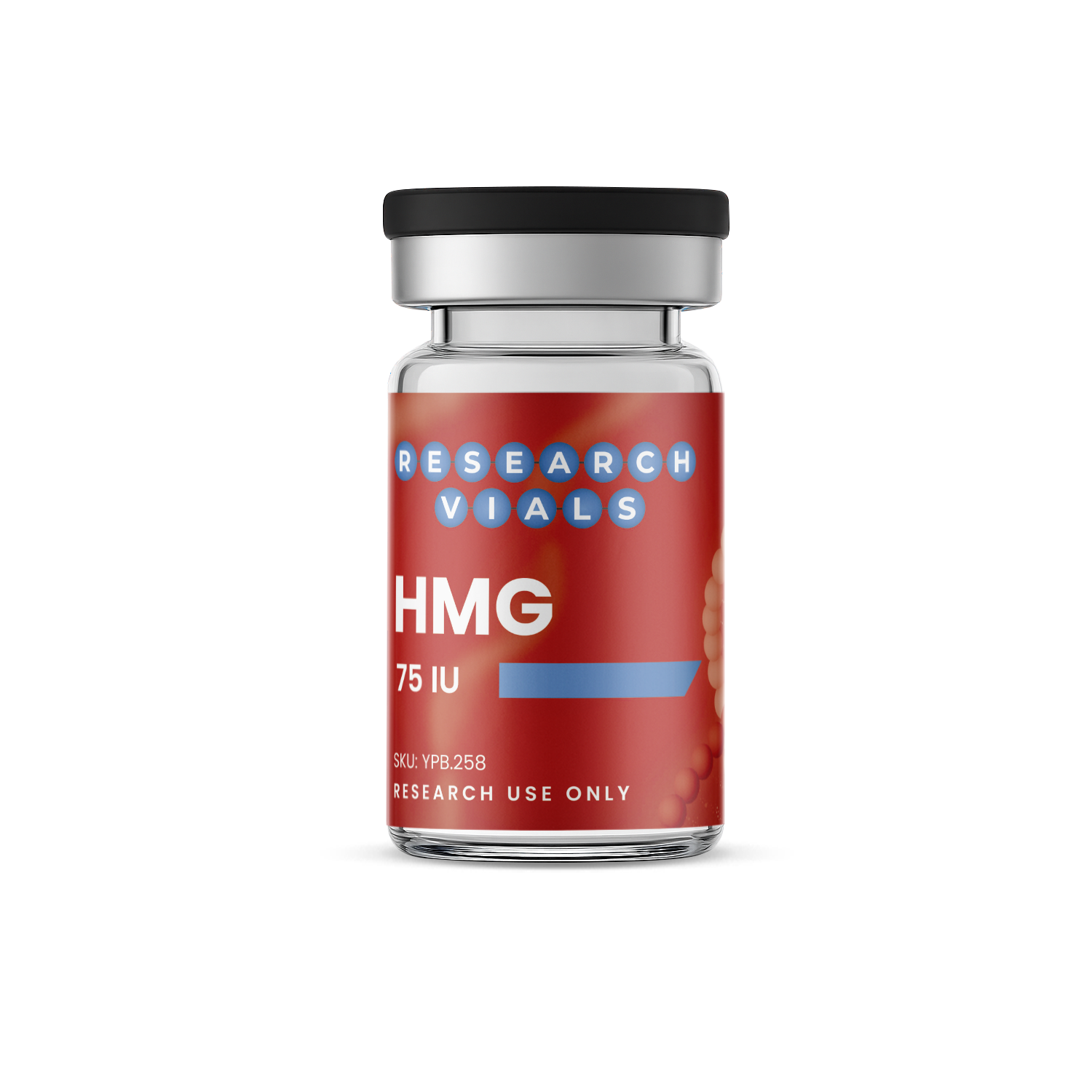
HMG (75iu)
$130.00
Additional information
| Weight | 0.0625 lbs |
|---|
Storage Instructions
All products from Research Vials are manufactured using a lyophilization (freeze-drying) process. This method is designed to maintain product integrity and allows vials to remain stable during shipping for approximately 3–4 months.
Once a vial is reconstituted with bacteriostatic water, it should be stored in the refrigerator to help maintain stability. Under these conditions, reconstituted material is generally considered stable for up to 30 days.
Lyophilization is a dehydration technique in which compounds are frozen and then exposed to low pressure. This causes the water in the vial to sublimate directly from solid to gas, leaving behind a stable, crystalline white structure. This powder can be kept at room temperature until reconstitution.
Upon receipt, products should be stored away from heat and light. For short-term use, refrigeration at approximately 4°C (39°F) is suitable. For long-term storage (several months to years), vials may be placed in a freezer at approximately -80°C (-112°F). Freezing is the preferred method for preserving product stability over extended periods.
⚠️ Important Notice:
These products are intended for research use only. Not for human consumption.
Research Use Only
These studies reference research-grade peptides for laboratory and scientific investigation only. Not for human consumption. Not intended to diagnose, treat, cure, or prevent any disease.
Published Scientific Research
Peer-reviewed laboratory research investigating research peptides from leading scientific databases
Gastric alarmin release: A warning signal in the development of gastric mucosal diseases.
Alarmins exist outside cells and are early warning signals to the immune system; as such, alarmin receptors are widely distributed on various immune cells. Alarmins, proinflammatory molecular patterns associated with tissue damage, are usually released into the extracellular space, where they induce immune responses and participate in the damage and repair processes of mucosal diseases.In the stomach, gastric alarmin release has been shown to be involved in gastric mucosal inflammation, antibacterial defense, adaptive immunity, and wound healing; moreover, this release causes damage and results in the development of gastric mucosal diseases, including various types of gastritis, ulcers, and gastric cancer.
View Full StudyMAP4K4 mediates the SOX6-induced autophagy and reduces the chemosensitivity of cervical cancer.
MAP4K4 mediated the SOX6-induced autophagy through inhibiting PI3K-Akt-mTOR pathway and activating MAPK/ERK pathway.
View Full StudyTwo human menopausal gonadotrophin (hMG) preparations display different early signaling in vitro.
The formation of FSH receptor and LH/hCG receptor (FSHR; LHCGR) heteromer, intracellular Ca2+ and cAMP activation, β-arrestin 2 recruitment and the synthesis of progesterone and estradiol were evaluated in transfected HEK293 and human primary granulosa lutein cells treated by drugs administered within the pg-mg/ml concentration range. While both drugs induced similar FSHR-LHCGR heteromeric formations and intracellular Ca2+ increase, Meriofert® had a higher potency than Menopur® in inducing a cAMP increase.
View Full StudyDual functions of Insig proteins in cholesterol homeostasis.
The molecular mechanism of how cells maintain cholesterol homeostasis has become clearer for the understanding of complicated association between sterol regulatory element-binding proteins (SREBPs), SREBP cleavage-activating protein (SCAP), 3-hydroxy-3-methylglutaryl coenzyme A reductase (HMG-CoA reductase) and Insuin induced-genes (Insigs).
View Full StudyTranscriptome profiling and the pathogenesis of diabetic complications.
The cellular mediators of high glucose-induced injury include activation of protein kinase C, accumulation of cell sorbitol from increased flux through the aldose reductase pathway, and generation of advanced glycosylation end products and reactive oxygen species, among others.
View Full StudyImpact of ovarian stimulation on corpus luteum function and embryonic implantation.
The luteal phase has been found to be defective in virtually all the stimulation protocols used in in-vitro fertilization (IVF), indicating that common mechanisms might be involved despite the use of different drugs.
View Full StudyRelated products
-
Wolverine Blend – BPC-157 (5mg) / TB500 (5mg) (Globally Sourced)
Price range: $56.00 through $90.00Select options This product has multiple variants. The options may be chosen on the product page -
-