

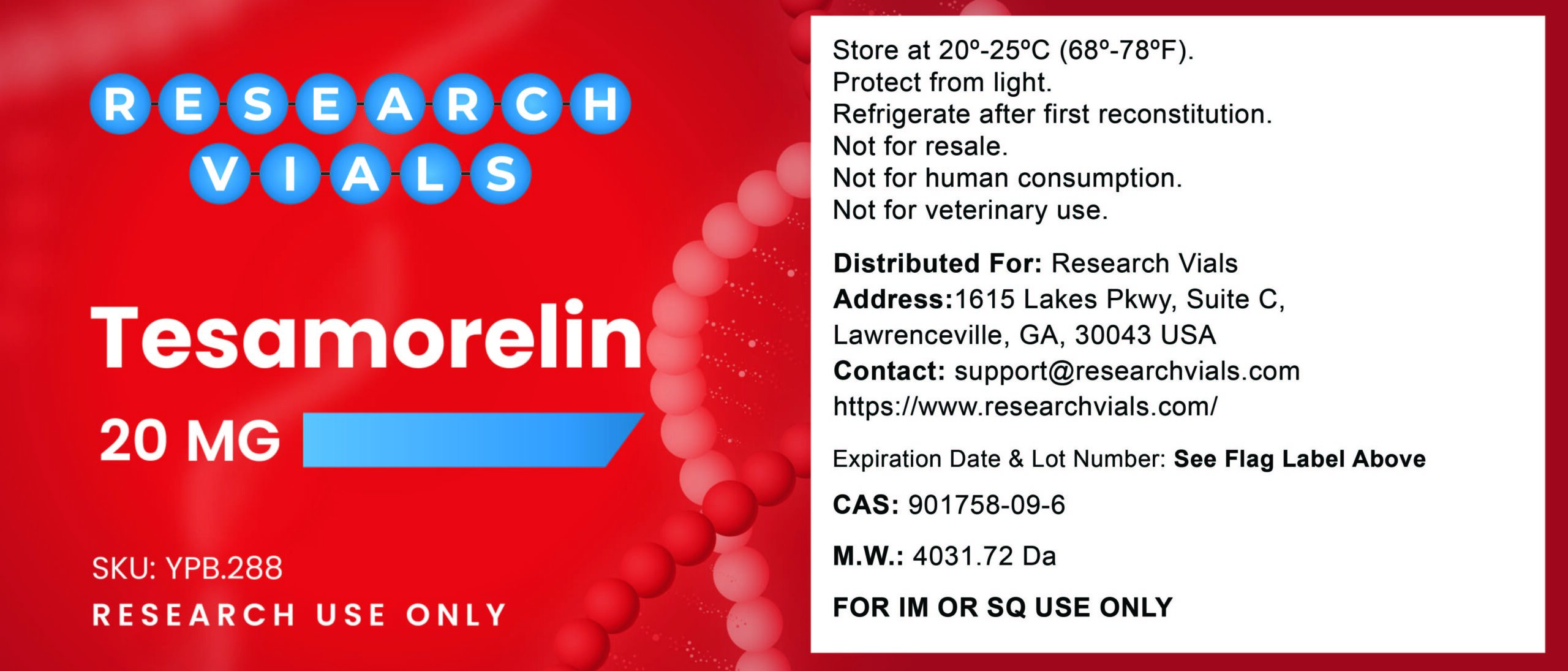
Tesamorelin (20mg)
$285.00
Description
A single-component research material supplied for controlled research environments. Tesamorelin (20 mg) is a synthetic 44-amino acid analog of growth hormone-releasing hormone (GHRH) with a trans-3-hexenoic acid modification at the N-terminus, widely used in research exploring GHRH receptor signaling, somatotroph axis regulation, and pulsatile growth hormone secretion dynamics in model systems. Composition: Tesamorelin (modified GHRH(1-44) analog): 20 mg. Appearance: lyophilized powder in a sealed research vial. Important Notice: For research use only. Not for human consumption. Not intended to diagnose, treat, cure, or prevent any disease.Additional information
| Weight | 0.0625 lbs |
|---|
Storage Instructions
All products from Research Vials are manufactured using a lyophilization (freeze-drying) process. This method is designed to maintain product integrity and allows vials to remain stable during shipping for approximately 3–4 months.
Once a vial is reconstituted with bacteriostatic water, it should be stored in the refrigerator to help maintain stability. Under these conditions, reconstituted material is generally considered stable for up to 30 days.
Lyophilization is a dehydration technique in which compounds are frozen and then exposed to low pressure. This causes the water in the vial to sublimate directly from solid to gas, leaving behind a stable, crystalline white structure. This powder can be kept at room temperature until reconstitution.
Upon receipt, products should be stored away from heat and light. For short-term use, refrigeration at approximately 4°C (39°F) is suitable. For long-term storage (several months to years), vials may be placed in a freezer at approximately -80°C (-112°F). Freezing is the preferred method for preserving product stability over extended periods.
⚠️ Important Notice:
These products are intended for research use only. Not for human consumption.
Research Use Only
These studies reference research-grade peptides for laboratory and scientific investigation only. Not for human consumption. Not intended to diagnose, treat, cure, or prevent any disease.
Published Scientific Research
Peer-reviewed laboratory research investigating growth hormone peptides from leading scientific databases
Injectable Peptide Therapy: A Primer for Orthopaedic and Sports Medicine Physicians.
RESULTS: BPC-157 demonstrated potential benefits in tendon and muscle repair, but these findings are largely unvalidated in human trials. CJC-1295 combined with ipamorelin showed significantly improved maximum tetanic tension in murine models with glucocorticoid-induced muscle loss, but these findings are limited to animal studies.
View Full StudyChromatographic-mass spectrometric analysis of peptidic analytes (2-10 kDa) in doping control urine samples.
With urine samples representing still the most frequently collected doping control specimens, efficient extraction of peptidic analytes from this matrix was a major goal of this method, as demonstrated for the included compounds such as insulins (human, lispro, aspart, glulisine, tresiba, glargine metabolite, bovine insulin, porcine insulin), growth hormone-releasing hormones (sermorelin, CJC-1295, tesamorelin) incl.
View Full StudyProbing for peptidic drugs (2-10 kDa) in doping control blood samples.
Bioactive peptides with a molecular mass between 2 and 10 kDa represent an important class of substances banned in elite sports, which has been recognized with an increasing number and variety of substances by anti-doping organizations. Also, the annually renewed list of prohibited substances of the World Anti-Doping Agency (WADA) explicitly mentions more and more of these peptides, and efficient testing procedures are required. Even under simplified sample preparation conditions, liquid chroma
View Full StudyAdvances in the detection of growth hormone releasing hormone synthetic analogs.
The administration of growth hormone releasing hormone (GHRH) and its synthetic analogs is prohibited by the World Anti-Doping Agency (WADA). Although there is evidence of their use, based on admissions and intelligence, they do not appear to have been found in anti-doping samples by WADA accredited laboratories. This might be due to their small concentration in urine and limited knowledge about their metabolism, especially for unapproved synthetic analogs. This study investigates the in vitro m
View Full StudyQualitative identification of growth hormone-releasing hormones in human plasma by means of immunoaffinity purification and LC-HRMS/MS.
The use of growth hormone-releasing hormones (GHRHs) is prohibited in sports according to the regulations of the World Anti-Doping Agency (WADA). The aim of the present study was to develop a method for the simultaneous detection of four different GHRHs and respective metabolites from human plasma by means of immunoaffinity purification and subsequent nano-ultrahigh performance liquid chromatography-high resolution/high accuracy (tandem) mass spectrometry. The target analytes included Geref (Ser
View Full StudyExpanded test method for peptides >2 kDa employing immunoaffinity purification and LC-HRMS/MS.
Bioactive peptides with an approximate molecular mass of 2-12 kDa are of considerable relevance in sports drug testing. Such peptides have been used to manipulate several potential performance-enhancing processes in the athlete's body and include for example growth hormone releasing hormones (sermorelin, CJC-1293, CJC-1295, tesamorelin), synthetic/animal insulins (lispro, aspart, glulisine, glargine, detemir, degludec, bovine and porcine insulin), synthetic ACTH (synacthen), synthetic IGF-I (lon
View Full Study