

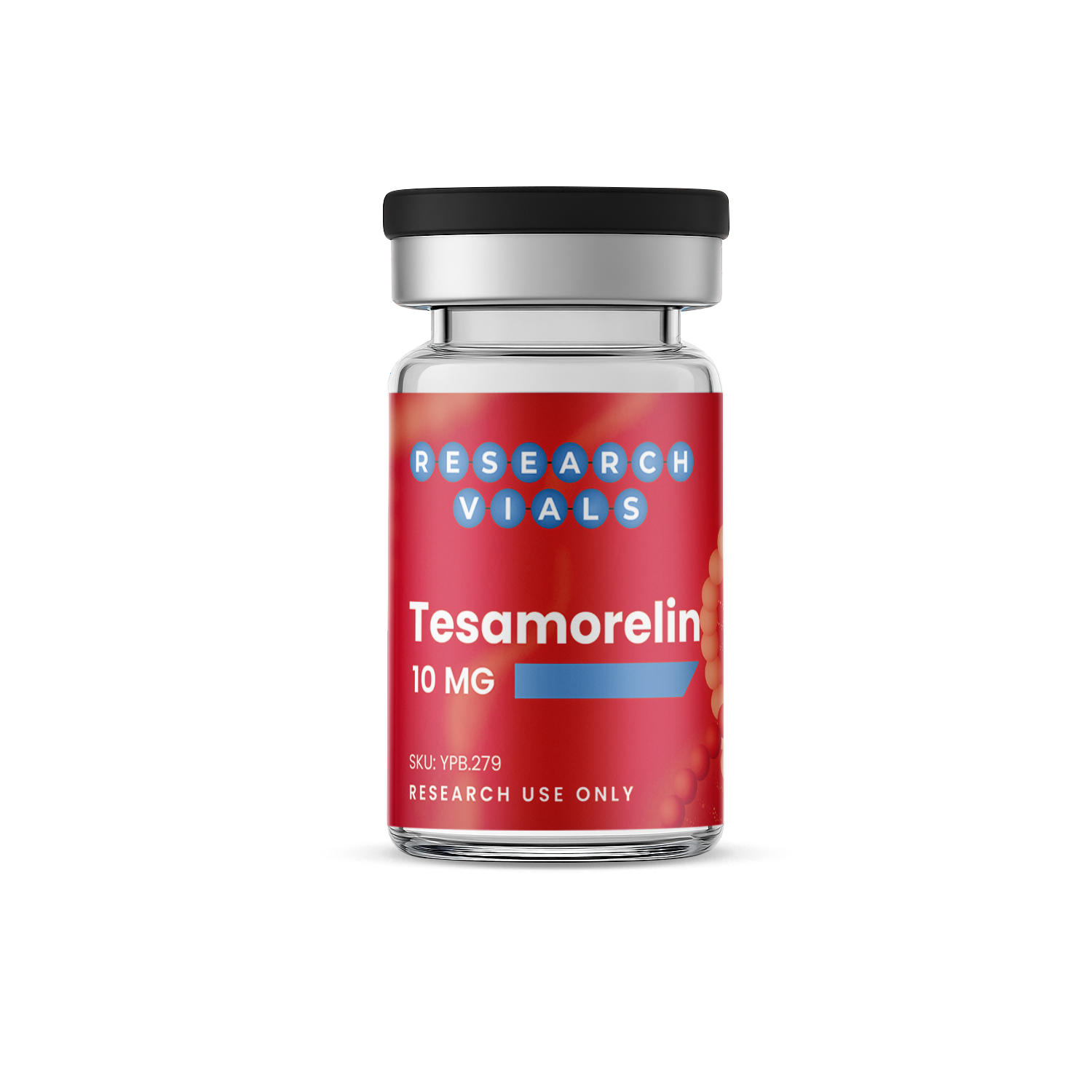
Tesamorelin is the only peptide on this catalog with a large, peer-reviewed, randomized controlled trial in humans backing its primary indication. The trial appeared in The New England Journal of Medicine in 2007. The molecule subsequently received FDA approval for HIV-associated lipodystrophy in 2010 under the trade name Egrifta. That regulatory path is unusual in this category and changes how the literature should be read. This page summarizes the work, the verification we run on each lot, and the practical handling notes.
We are a research-supply operation, not a clinical lab. Everything below is intended for licensed research use only.
What Tesamorelin actually is
Tesamorelin is a synthetic 44-amino-acid analog of growth-hormone-releasing hormone (GHRH 1-44) with a trans-3-hexenoic-acid modification at the N-terminus. The modification is what slows enzymatic degradation by dipeptidyl peptidase IV (DPP-IV), the enzyme that inactivates native GHRH within minutes. The longer half-life is the reason Tesamorelin was clinically tractable where native GHRH had not been.
Molecular weight is about 5,196 g/mol. That makes it one of the larger peptides we list, with handling characteristics that reflect the size: slower hydration, more sensitivity to mechanical agitation, longer reconstitution windows.
How we verify our Tesamorelin batches
Larger peptides are harder to make purely than shorter ones, and longer chains accumulate more synthesis errors per molecule. We run every lot through Analytical Formulations, Inc.0% by area) and mass-spec identity confirmation against the calculated [M+H]+ of 5,197 Da. The lab report stays on file and is posted to the Tesamorelin product page.
Common reject findings on 40+ residue peptides include deletion-sequence variants (the synthesis machine drops a residue) that show up at -100 to -150 Da from target. Our acceptance threshold catches these on the chromatogram. We have rejected one Tesamorelin lot in the past nine months on this profile.
Reconstitution protocol we use in-house
Tesamorelin needs a slower, gentler reconstitution than smaller peptides:
- Bring the vial to room temperature for 20-25 minutes. Larger peptides are more vulnerable to thermal shock at the reconstitution step than smaller ones.
- Use bacteriostatic water (0.9% benzyl alcohol).
- Add water down the inside wall of the vial as slowly as the syringe allows. Do not let the stream impact the lyophilized cake directly — that causes localized over-concentration and aggregation that can take hours to redissolve.
- Swirl gently for 60-90 seconds. Do not shake. A 44-residue peptide will foam aggressively under shaking and the foam takes 30+ minutes to settle.
- Hold for 8-10 minutes before drawing. Full hydration of the lyophilized cake is slower for larger peptides; pulling early will give variable concentrations across draws.
A 5 mg vial reconstituted to 2 mL gives 2.5 mg/mL. Mark the reconstitution date on the cap.
Stability — what we observe in our cold-chain
Reconstituted Tesamorelin holds for 14 days at 2-8°C in our hands, on the shorter end of the catalog. The trans-3-hexenoic-acid modification is what protects against DPP-IV in vivo; in solution at refrigerator temperature, slow hydrolysis of that modification is the rate-limiting stability feature. Above 8°C the rate accelerates significantly.
We publish a 14-day usable window on the product page. For research designs that need longer hold, aliquot and freeze at -20°C immediately after reconstitution. The lyophilized form is stable refrigerated for the published shelf life.
What the published research actually says
The pivotal trial is Falutz J et al., “Metabolic effects of a growth hormone-releasing factor in patients with HIV,” NEJM, 2007 (doi:10.1056/NEJMoa072375). The study randomized HIV-infected adults with abdominal lipohypertrophy to Tesamorelin or placebo and reported a clinically meaningful reduction in visceral adipose tissue in the treatment group. Follow-up studies through 2010 supported FDA approval for that specific indication.
Subsequent research has examined Tesamorelin in non-HIV populations including NAFLD/MASLD and in cognitive-aging contexts. Stanley TL and colleagues have published on hepatic-fat reduction in NAFLD. The cognitive-aging literature is smaller and more preliminary.
Tesamorelin is meaningfully different from most of the catalog in one important respect: there is a real human RCT supporting one specific use case, with clear effect sizes and side-effect profiles documented in the regulatory record. Researchers extrapolating to other use cases should still treat that as a separate question from the indicated one.
Common questions from researchers
How is Tesamorelin different from CJC-1295 or Sermorelin? All three are GHRH-axis molecules. Sermorelin is GHRH (1-29) — a truncation. CJC-1295 is also GHRH (1-29) with bioconjugation modifications (the “with DAC” version adds a maleimidopropionic-acid linker for albumin binding). Tesamorelin is full-length GHRH (1-44) with a different N-terminal modification. Different pharmacokinetics, different potencies, different research questions.
Is FDA approval relevant to research-use-only material? The molecule is the same. The regulatory status of the branded product is separate from research-grade material handling. We list research-grade Tesamorelin at our standard verification threshold; the existence of an approved product does not change the supply chain or the verification we run.
Does the powder dissolve completely? Yes, with patience. The most common cause of incomplete dissolution is impatient draws — pulling at 2-3 minutes instead of 8-10 minutes after water addition.
Storage in the lyophilized form — refrigerated or frozen? Refrigerated for short-term, frozen at -20°C for long-term. The lyophilized cake is the most stable state.
Related compounds we test
For researchers in the GH-axis literature: CJC-1295 (no DAC) and CJC-1295 (with DAC) are the GHRH (1-29) analogs in the catalog, and Sermorelin is the natural-sequence truncation. Ipamorelin operates on a different receptor (the GH secretagogue receptor) and is often paired with GHRH-axis molecules in research. Each runs through the same independent verification at Analytical Formulations, Inc.