

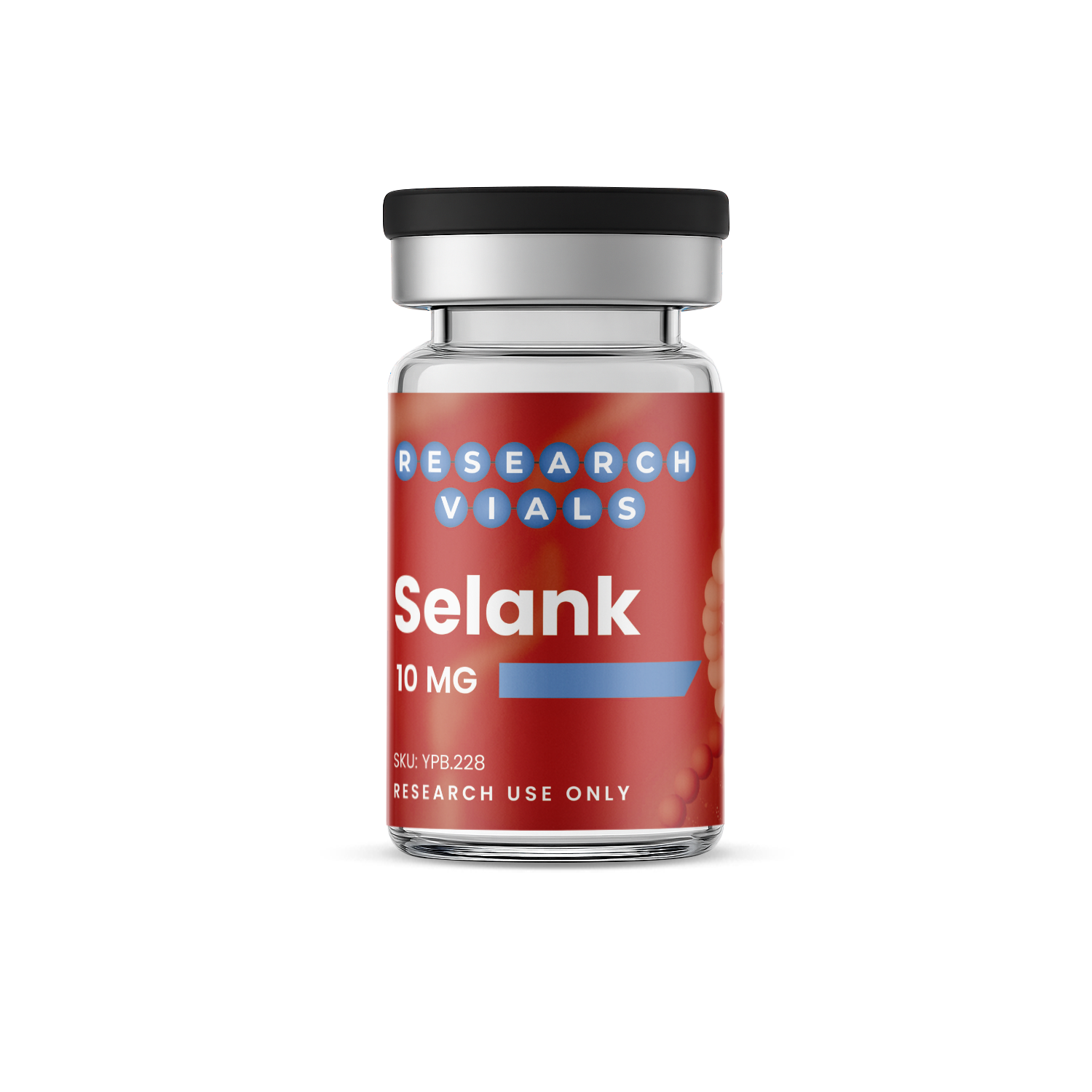
Selank is one of two synthetic peptides — Selank and Semax — that came out of the same Russian research program on neuropeptide modification in the late 1980s and early 1990s. Both modify a short fragment of a naturally-occurring molecule to extend its half-life. Selank’s parent fragment is tuftsin, a phagocyte-stimulating peptide. The modification keeps the activity-relevant residues and adds a stabilizing tail. This page summarizes what the research literature actually says, the verification process we run on each lot, and how we handle the material once it arrives.
We are a research-supply operation, not a clinical lab. Everything below is intended for licensed research use only.
What Selank actually is
Selank is a synthetic heptapeptide with the sequence Thr-Lys-Pro-Arg-Pro-Gly-Pro. The first four residues (Thr-Lys-Pro-Arg) are the tuftsin sequence. The added Pro-Gly-Pro tail dramatically slows enzymatic degradation, which is why the parent tuftsin has a half-life measured in seconds while Selank survives long enough to be useful in research.
Molecular weight is around 751 g/mol. The peptide is bridge-free, water-soluble, and does not require refolding after lyophilization.
How we verify our Selank batches
Every lot we list is verified by Analytical Formulations, Inc. as an independent third-party check on top of the supplier’s COA.0% by area) plus mass-spectrometry identity confirmation. The lab report is retained on file and posted to the Selank product page.
The most common reject reason on heptapeptides is racemization of the proline residues during synthesis. Our acceptance threshold catches racemic contamination on the chromatogram before a lot lists. We have rejected two lots in the past nine months on this category of finding.
Reconstitution protocol we use in-house
Selank reconstitutes cleanly:
- Bring the vial to room temperature on the bench for 10-15 minutes.
- Use bacteriostatic water (0.9% benzyl alcohol). For nasal-formulation research designs the appropriate vehicle differs; pick the matrix that matches the use, not whichever is in the fridge.
- Add water down the inside wall of the vial. Swirl gently for 30 seconds.
- Hold for 3 minutes before drawing.
An 11 mg vial reconstituted to 2 mL gives 5.5 mg/mL. Mark the reconstitution date on the cap.
Stability — what we observe in our cold-chain
Reconstituted Selank holds reasonably well. Supplier guidance is 21-28 days at 2-8°C and our visual checks across multiple batches have stayed clean inside that window. Above 8°C the proline-rich backbone is more vulnerable to thermal degradation than a typical proline-poor peptide; we discard any vial that has spent more than two hours above the refrigerator threshold.
We publish a 21-day usable window on the product page. Aliquot and freeze at -20°C if longer hold is needed.
What the published research actually says
The literature on Selank is, like Epitalon, weighted toward Russian-language preclinical and small clinical work. The original characterization papers come from Ashmarin’s lab at the Institute of Molecular Genetics in Moscow. Anxiolytic-effect work in rodent models has been published in Neuroscience and Behavioral Physiology and Bulletin of Experimental Biology and Medicine over multiple decades.
A practical reference point in English is Volchegorskii IA et al., 2007, on Selank effects in rodent anxiety models in Bulletin of Experimental Biology and Medicine. Western replication remains sparse. There is no large independently-conducted randomized controlled trial in humans we can cite.
Selank’s mechanism overlaps with the benzodiazepine GABA system in some readings of the data and with TNF-α / cytokine modulation in others; both are described in the Russian preclinical body of work. Researchers should treat the mechanism question as not fully settled.
Common questions from researchers
What’s the difference between Selank and Semax? Different parent fragments. Selank derives from tuftsin (Thr-Lys-Pro-Arg). Semax derives from ACTH (4-7), Met-Glu-His-Phe. Both add a Pro-Gly-Pro stabilizer tail. Both come from the same research program. Different downstream pharmacology.
Why is intranasal so commonly referenced? The Russian clinical literature on Selank used intranasal delivery primarily, and that is the route most of the rodent translational work was modeled around. Intranasal delivery and injectable delivery are not interchangeable for research design.
Should it be stored frozen lyophilized? Short term, no — refrigerated is fine. For multi-month storage, frozen is preferred. The lyophilized form is the most stable state.
Is the powder hygroscopic? Yes, mildly. Cap immediately after opening and minimize bench-air exposure.
Related compounds we test
The natural companion in this catalog is Semax — same research program, different parent fragment. For researchers working on the broader nootropic-frame literature, N-Acetyl Semax variants and the Khavinson bioregulator series (Pinealon, Epitalon) sit in adjacent literatures. Each runs through the same independent verification at Analytical Formulations, Inc.