

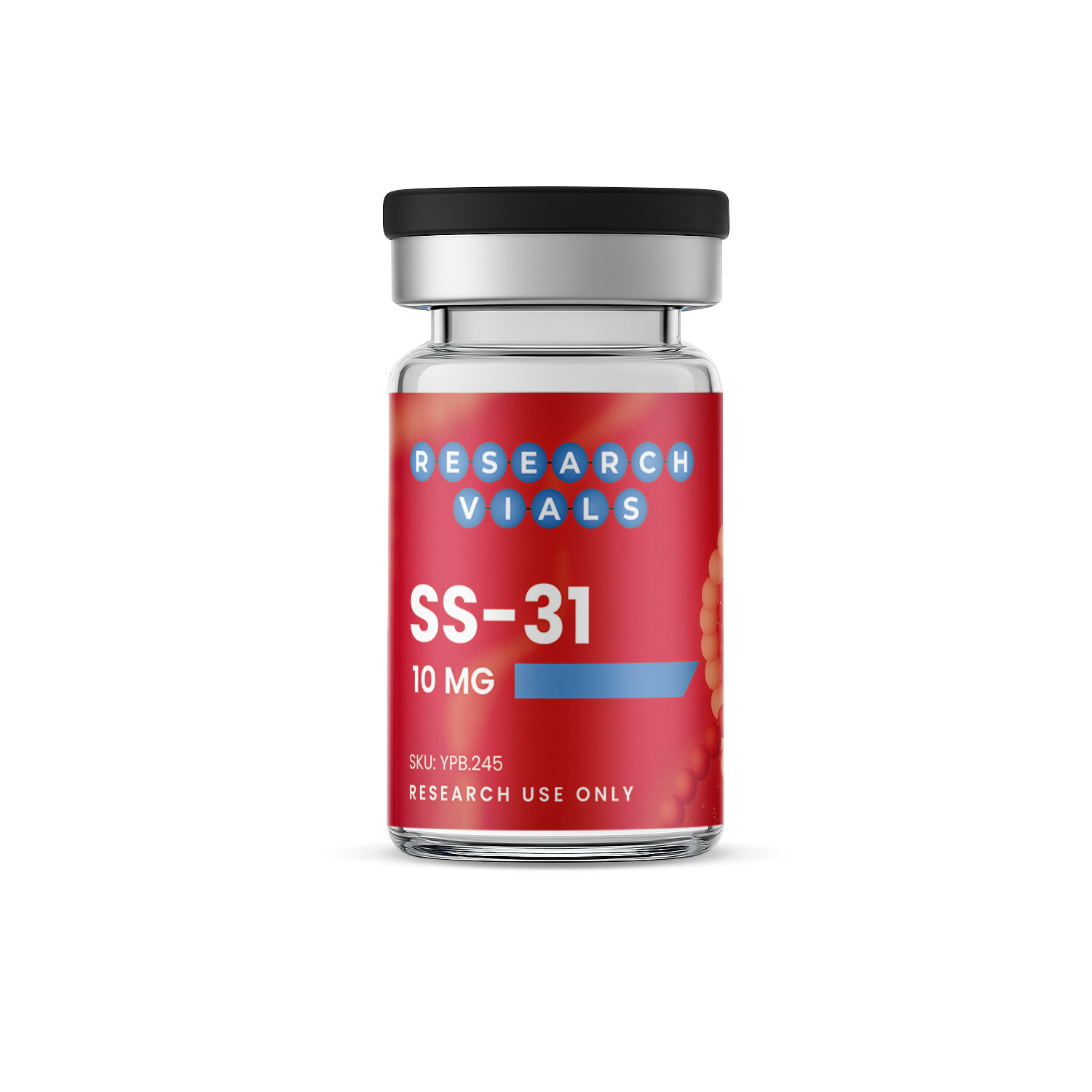
SS-31 is unusual on a research catalog because the design intent was specific from the start. Hazel Szeto and Peter Schiller built it in the early 2000s as a mitochondrially-targeted antioxidant — a small peptide engineered to cross the inner mitochondrial membrane and bind cardiolipin, a phospholipid found almost exclusively in that membrane. That mechanism is what makes the molecule interesting and what shapes how it has to be handled. This page summarizes that work, the verification we run on each lot, and the practical handling notes.
We are a research-supply operation, not a clinical lab. Everything below is intended for licensed research use only.
What SS-31 actually is
SS-31 (also known as MTP-131 and elamipretide) is a synthetic tetrapeptide with the sequence D-Arg-Tmt-Lys-Phe-NH₂. “Tmt” is 2,6-dimethyltyrosine, an unnatural amino acid that contributes to membrane permeability. The C-terminal amide and the alternating cationic/aromatic pattern are what give the peptide its targeting behavior — the inner mitochondrial membrane is unusually anionic compared to other cellular membranes, and SS-31 partitions there preferentially.
Molecular weight is around 640 g/mol. The lyophilized form is a white-to-off-white powder; reconstituted SS-31 is colorless to faintly straw.
How we verify our SS-31 batches
The Tmt residue is a synthesis specialty — not every supplier handles it cleanly. We run every lot through Analytical Formulations, Inc.0% by area) and mass-spectrometry identity confirmation against the calculated [M+H]+ of 640.4 Da. Lab reports stay on file and are posted to the SS-31 product page.
The most common Tmt-related synthesis failure is incomplete N-methylation, which shows up at the expected mass minus 14 or 28 Da. Our acceptance threshold catches this before a lot lists. We rejected one lot in the past year on this profile.
Reconstitution protocol we use in-house
SS-31 is more hydrophobic than most peptides we list, which changes the protocol slightly:
- Bring the vial to room temperature on the bench for 15-20 minutes.
- Use bacteriostatic water (0.9% benzyl alcohol). The peptide will dissolve, but expect 60-90 seconds of swirling rather than the 15-30 seconds you would see with Epitalon or KPV.
- Add water down the wall of the vial. Swirl gently. Do not shake — the modest hydrophobicity makes foam formation more aggressive than on hydrophilic peptides, and the foam takes 30+ minutes to settle.
- Hold for 5 minutes before drawing.
A 10 mg vial reconstituted to 2 mL gives 5 mg/mL. Mark the reconstitution date on the cap.
Stability — what we observe in our cold-chain
Reconstituted SS-31 holds for 21 days at 2-8°C in our hands. Supplier guidance generally cites 14-21 days. The aromatic Tmt residue is the most likely point of slow degradation if a lot is held outside the cold chain — we have observed measurable purity drift on a vial accidentally left at 12°C for 36 hours during a fridge incident, and that vial was discarded.
We publish a 21-day usable window on the product page. For longer hold, aliquot and freeze at -20°C immediately after reconstitution. The lyophilized form is stable refrigerated for the published shelf life.
What the published research actually says
Szeto’s lab is the entry point. The 2014 Br J Pharmacol review describes the cardiolipin-binding mechanism and the design rationale (Szeto HH. Br J Pharmacol. 2014;171(8):2029-50. doi:10.1111/bph.12461). Earlier mechanistic work on selective membrane targeting and antioxidant action appears in Zhao K et al., J Biol Chem. 2004 (doi:10.1074/jbc.M409902200).
Human clinical work on the elamipretide form has been pursued by Stealth BioTherapeutics in mitochondrial-disease populations including Barth syndrome and primary mitochondrial myopathy. Phase 2 and Phase 3 trial readouts have been mixed. The peptide has not received broad regulatory approval as of this writing. Researchers should not treat the mechanism evidence and the late-stage clinical evidence as the same kind of certainty.
Common questions from researchers
Is SS-31 the same as elamipretide? Same molecule. SS-31 is the academic name; MTP-131 was an earlier development code; elamipretide is the INN used in clinical-stage research.
Why does it foam more than other peptides on shaking? The Tmt and Phe residues make the molecule more amphipathic than a typical hydrophilic short peptide. Amphipathic molecules foam. Swirl, do not shake.
Can we lyophilize back from solution? Possible, but the reconstituted-then-relyophilized material has shown 1-3% peptide-purity loss per cycle in our checks. We do not recommend it.
Does it tolerate freeze-thaw? A small number of cycles, yes. After 5+ cycles we see measurable degradation. Aliquot to single-use volumes if you anticipate repeated draws.
Related compounds we test
For researchers building mitochondrial-axis comparisons: MOTS-c is the natural companion, encoded in mitochondrial DNA itself rather than designed to target the organelle from outside. For broader cellular-energy work, NAD+ precursors sit in an adjacent mechanism. Each runs through the same independent verification at Analytical Formulations, Inc.