

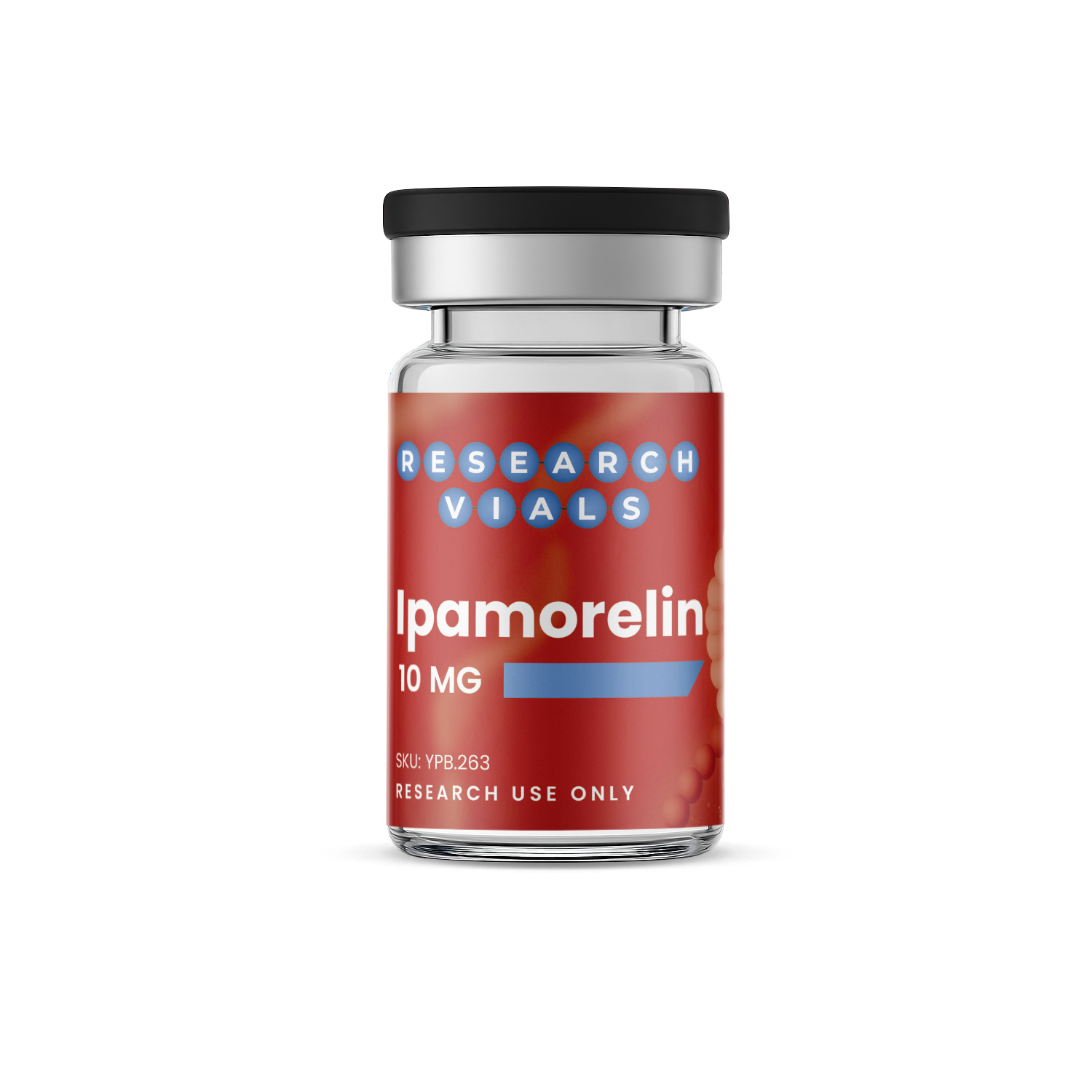
Ipamorelin gets called the “clean” growth-hormone-releasing peptide in research literature, and the reason is specific. The first generation of GH-secretagogue peptides — GHRP-2, GHRP-6, hexarelin — were potent, but they also drove cortisol and prolactin release on top of the GH release that was the design intent. Ipamorelin was the first molecule in that family to show GH-releasing activity without that off-target endocrine signal in animal models. This page summarizes that work, the verification we run on each lot, and the practical handling notes.
We are a research-supply operation, not a clinical lab. Everything below is intended for licensed research use only.
What Ipamorelin actually is
Ipamorelin is a synthetic pentapeptide with the sequence Aib-His-D-2-Nal-D-Phe-Lys-NH₂. Two of the residues are non-standard amino acids: Aib is α-aminoisobutyric acid (a non-natural Cα-tetrasubstituted amino acid that resists peptidase cleavage), and D-2-Nal is the D-isomer of 2-naphthylalanine. The C-terminal amide further protects against carboxypeptidases.
The combination of these modifications gives Ipamorelin a longer plasma half-life than its natural-amino-acid analogs and is part of why the receptor-selectivity profile is cleaner — the unnatural residues fit the GH secretagogue receptor binding pocket without engaging adjacent receptors that drive cortisol and prolactin.
Molecular weight is about 712 g/mol.
How we verify our Ipamorelin batches
Peptides with non-natural amino acids are harder to synthesize cleanly than peptides built from the standard 20 — every Aib and D-2-Nal residue is a specialty incorporation step. We run every lot through Analytical Formulations, Inc.0% by area) and mass-spec identity confirmation against the calculated [M+H]+ of 712.4 Da. The lab report is retained on file and posted to the Ipamorelin product page.
The most common synthesis-related reject finding is racemization at the D-Phe and D-2-Nal positions — under suboptimal coupling conditions some fraction of the material ends up with the L-isomer at one of those positions, and that material has different pharmacology. The chromatogram shows the racemic contamination as a shoulder on the main peak. We rejected one lot in the past nine months on this profile.
Reconstitution protocol we use in-house
Ipamorelin reconstitutes cleanly:
- Bring the vial to room temperature for 10-15 minutes.
- Use bacteriostatic water (0.9% benzyl alcohol).
- Add water down the wall of the vial. Swirl gently for 30 seconds.
- Hold for 3-5 minutes before drawing.
A 10 mg vial reconstituted to 2 mL gives 5 mg/mL. Mark the reconstitution date on the cap.
Stability — what we observe in our cold-chain
Reconstituted Ipamorelin holds for 21-28 days at 2-8°C in our hands. The Aib residue and the C-terminal amide are both stability features that protect against the kinds of slow hydrolytic events that shorten the usable window for unmodified pentapeptides at refrigerator temperature.
We publish a 21-day usable window on the product page out of conservative defaults across the catalog. For research designs that need extended hold, aliquot and freeze at -20°C; the lyophilized form is the most stable state and is what the published shelf life is anchored to.
What the published research actually says
The original characterization paper is Raun K et al., “Ipamorelin, the first selective growth hormone secretagogue,” European Journal of Endocrinology, 1998 (doi:10.1530/eje.0.1390552). That paper established the GH-release activity in rats and pigs and made the case for the cortisol/prolactin selectivity that subsequently became the molecule’s identifying feature in the research literature.
Follow-up work from the Helsinn / Helsinn Birex Pharmaceuticals development program in the 2000s carried Ipamorelin into Phase 2 clinical trials for postoperative ileus. Those trials produced mixed results — some endpoints met, others did not — and broad regulatory approval did not follow. The molecule has subsequently remained relevant in research contexts including muscle-wasting models and GH-axis pharmacology.
Human clinical evidence is therefore intermediate: there is real Phase 2 data, but it does not converge on a single approved indication. Researchers should treat the GH-release-pharmacology evidence as more settled than the outcome-level evidence in any specific patient population.
Common questions from researchers
Why is Ipamorelin called “selective” when it acts on the GH secretagogue receptor like GHRP-2 and GHRP-6? The selectivity claim is about downstream endocrine effects, not about which receptor it binds. All three engage the GH secretagogue receptor (now called GHSR-1a or the ghrelin receptor). The difference is that Ipamorelin’s binding profile drives GH release without the cortisol and prolactin elevation seen with the earlier GHRPs.
Can Ipamorelin be paired with a GHRH analog? Ipamorelin and GHRH analogs (Tesamorelin, CJC-1295, Sermorelin) act on different receptors. Pairing them in research designs is common because the two pathways are synergistic at the pituitary. The catalog 2X blend combines Ipamorelin with CJC-1295 (no DAC) for that purpose.
Does the powder need to be protected from light? Standard amber vial storage is sufficient. The naphthalene side chain is mildly photosensitive but bench exposure during a normal draw is not an issue.
Storage in the lyophilized form — refrigerated or frozen? Refrigerated short term, frozen long term. The lyophilized cake is the most stable state.
Related compounds we test
For researchers in the GH-axis literature: CJC-1295 (no DAC) and CJC-1295 (with DAC) are the GHRH-axis pairing partners, and Tesamorelin is the regulatory-approved GHRH analog in the catalog. Hexarelin and GHRP-6 are the older-generation GH secretagogues that Ipamorelin was developed to improve on. Each runs through the same independent verification at Analytical Formulations, Inc.