

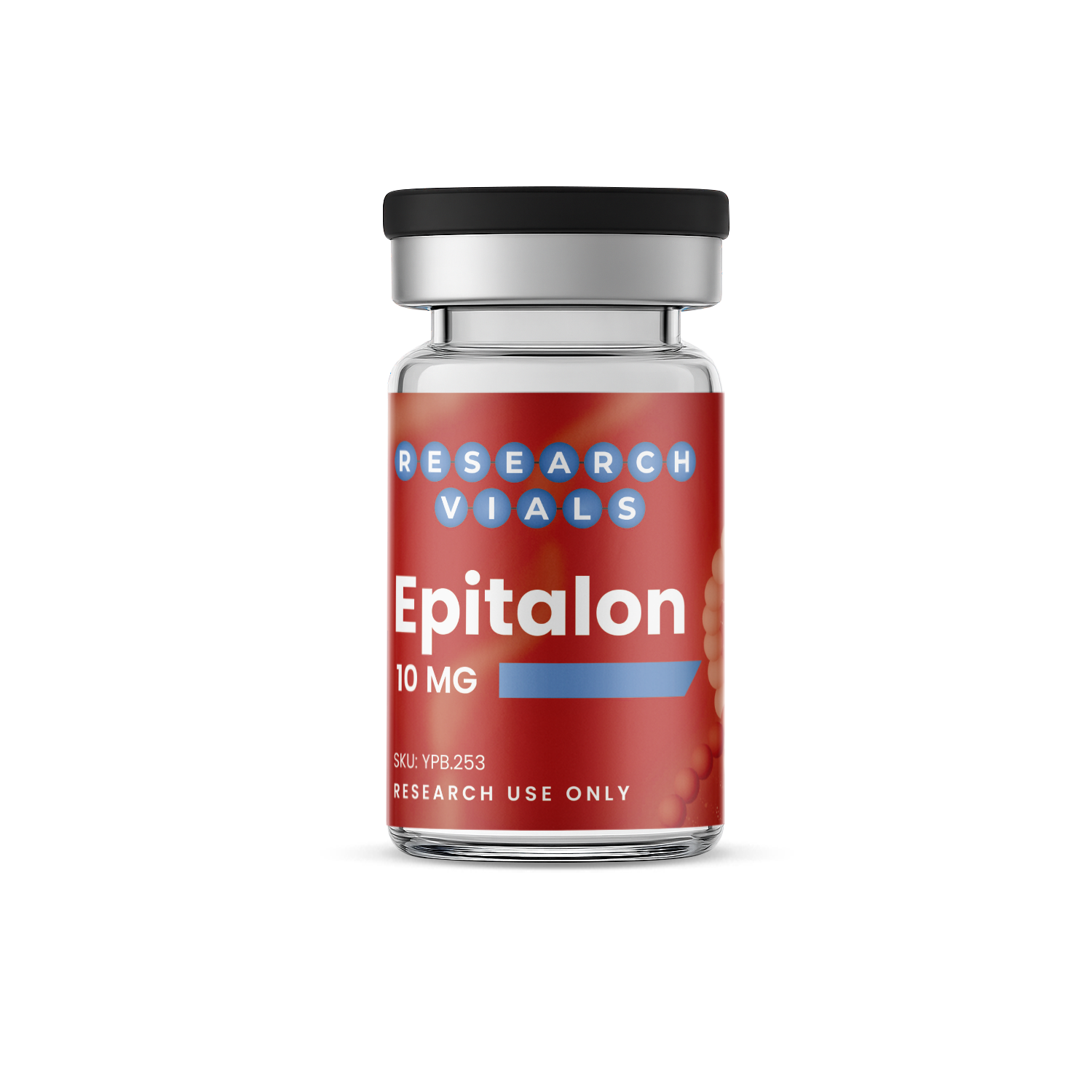
Epitalon is a four-amino-acid peptide developed inside the Soviet/Russian gerontology research tradition rather than the Western pharma pipeline, which is part of why the literature on it reads differently from most peptides on a modern catalog. This page summarizes what is actually published, where the evidence is solid, where it isn’t, and how we handle the material on our end.
We are a research-supply operation, not a clinical lab. Everything below is intended for licensed research use only.
What Epitalon actually is
Epitalon (also Epithalon, Epithalamin) is a synthetic tetrapeptide with the sequence Ala-Glu-Asp-Gly. It was developed in the 1990s at the St. Petersburg Institute of Bioregulation and Gerontology by Vladimir Khavinson and colleagues, derived from work on a longer pineal-gland extract called Epithalamin.
Tetrapeptides are at the small end of what we list — molecular weight around 390 g/mol. That makes Epitalon highly soluble, rapidly hydrating on reconstitution, and forgiving on most handling errors that would compromise larger peptides.
How we verify our Epitalon batches
Each lot ships with the supplier’s COA. We then run the lot through Analytical Formulations, Inc.0% by area) and a mass-spectrometry identity confirmation against the calculated [M+H]+ for Ala-Glu-Asp-Gly. We retain the report on file and post it to the Epitalon product page.
Short peptides are easier to make purely than long ones, so Epitalon lots tend to read clean. We have not rejected an Epitalon lot in the past year on purity grounds — the more common reject reason at our acceptance threshold is residual TFA from synthesis, which the supplier handles upstream.
Reconstitution protocol we use in-house
Epitalon dissolves cleanly:
- Bring the vial to room temperature for 10-15 minutes.
- Add bacteriostatic water (0.9% benzyl alcohol) down the wall of the vial.
- Swirl gently for 15-20 seconds. The solution should clear immediately — Epitalon is one of the easier peptides to fully hydrate.
- Hold for 2 minutes before drawing.
A 10 mg vial reconstituted to 2 mL gives 5 mg/mL. Mark the reconstitution date on the cap.
Stability — what we observe in our cold-chain
Reconstituted Epitalon is reasonably stable. Supplier guidance is 21-30 days at 2-8°C, and our visual checks across multiple batches have not shown clarity issues inside that window when the vial is held in a calibrated fridge.
That said, we publish a 21-day usable window on the product page rather than 30 because customer storage conditions vary and we will not vouch for a vial we have not personally observed at the longer hold. For research designs that need extended hold, aliquot and freeze at -20°C; the lyophilized form is the most stable state and we recommend reconstituting only what will be used in the working window.
What the published research actually says
The literature is structurally lopsided. The Russian-language preclinical and small-clinical body of work spans three decades and is published primarily in journals like Bulletin of Experimental Biology and Medicine and Advances in Gerontology. The English-language translations exist for many of these but are often abbreviated.
The most-cited claim — that Epitalon induces telomerase activity in human somatic cells — traces back to Khavinson VK et al., Bulletin of Experimental Biology and Medicine, 2003, “Epithalon peptide induces telomerase activity and telomere elongation in human somatic cells.” A clinical-population mortality follow-up was later reported by Khavinson and colleagues in long-term observational cohorts. Western replication is sparse. There is no large, independently-conducted randomized controlled trial in humans we can cite.
Researchers planning to extrapolate from this body of literature should treat the geographic and methodological asymmetry honestly: the case for further investigation is supported, the case for confident extrapolation to outcomes is not.
Common questions from researchers
Is Epitalon the same as Epithalamin? No. Epithalamin is a polypeptide extract of bovine pineal gland — a multi-component biological. Epitalon is a synthetic tetrapeptide derived from working out which fragment of the extract carried the activity.
Why is the literature so Russia-heavy? Because Khavinson’s lab originated the molecule and built three decades of follow-up around it. That isn’t a red flag on its own, but it does mean independent replication is what would advance confidence in the strongest claims, and that has been slow to materialize.
Does it need to be refrigerated lyophilized? Short term, no. Lyophilized Epitalon tolerates room temperature shipping. Long-term storage is recommended at 2-8°C. Reconstituted material always at 2-8°C.
Is the powder white or off-white? White to off-white. A yellow tinge can indicate oxidation and the lot should be flagged.
Related compounds we test
For researchers in the bioregulator family, Pinealon is another short peptide from the same Khavinson research lineage. For longevity-frame comparisons in a different mechanism, N-Acetyl Epitalon Amidate is a modified analog. Each runs through the same independent verification at Analytical Formulations, Inc.