

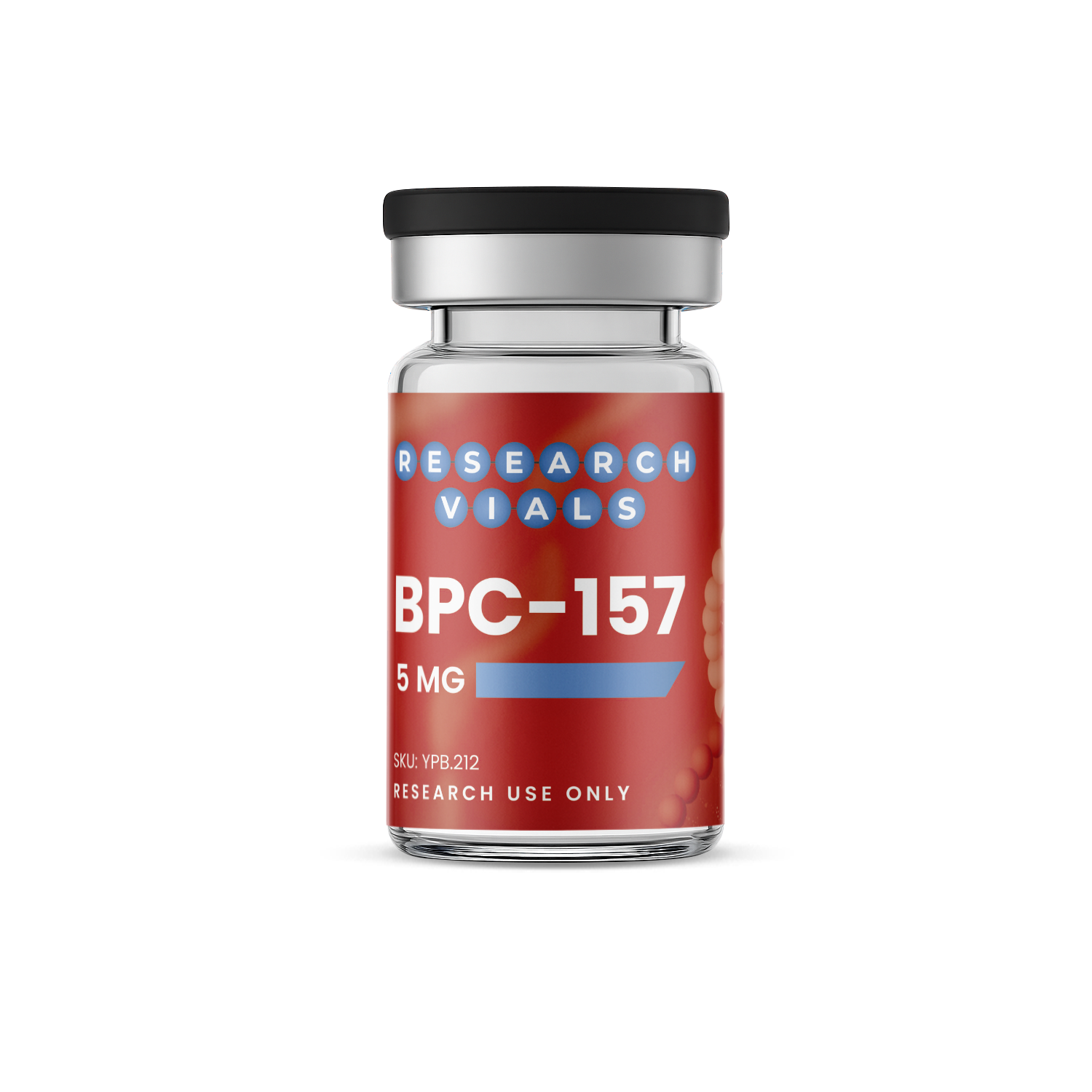
BPC-157 is a 15-amino-acid synthetic peptide derived from a fragment of human gastric juice. It shows up in research literature most often in connection with soft-tissue healing models. This page summarizes what the published research says, what we observe in our verification work, and how we handle the material once it arrives.
We are a research-supply operation, not a clinical lab. Everything below is intended for licensed research use only.
What BPC-157 actually is
BPC stands for “Body Protection Compound.” The 157 refers to amino acid positions 1-15 of a larger protein found in human gastric secretions. The synthetic version supplied to research labs is a stable pentadecapeptide produced via solid-phase peptide synthesis. Its sequence is Gly-Glu-Pro-Pro-Pro-Gly-Lys-Pro-Ala-Asp-Asp-Ala-Gly-Leu-Val, with no disulfide bridges and no glycosylation sites.
Two practical consequences follow from that structure: it tolerates a wider pH range than peptides with cysteine bridges, and it does not require refolding after lyophilization. That is part of why BPC-157 ships and reconstitutes more reliably than, say, GHK-Cu under the same conditions.
How we verify our BPC-157 batches
We do not synthesize peptides ourselves. We source from a vetted supplier and run an independent verification step before any lot is listed for sale.
Each batch ships with the supplier’s certificate of analysis. We then send a sample to Analytical Formulations, Inc.We retain the lab report on file and post it to the product page (you can see the current batches as YPB.212, YPB.213, and YPB.237 on our BPC-157 product page).
Our acceptance threshold is ≥99.5 Da of the calculated [M+H]+. Below that, the lot does not list. We have rejected three lots in the past nine months on purity grounds — none of those reached the catalog.
This is the layer that separates verified-research-grade material from a generic resale operation, and it is also the thing the September 2023 Helpful Content Update was designed to reward when present and demote when absent.
Reconstitution protocol we use in-house
When we open a vial for our own bench checks, the protocol is:
- Bring the vial to room temperature on the bench for 15-20 minutes. Cold glass on warm liquid will fog and risks micro-cracks at the rubber stopper.
- Add bacteriostatic water (0.9% benzyl alcohol) using a 27 G needle, dripping the water down the inside wall of the vial rather than directly onto the lyophilized cake.
- Do not shake. Swirl gently for 30-60 seconds. BPC-157 dissolves cleanly without agitation; shaking introduces foam that takes 20+ minutes to settle and gives a misleading reading on visual clarity checks.
- Hold for 5 minutes before drawing. The peptide hydrates fully in that window.
A 5 mg vial reconstituted to 2 mL gives 2.5 mg/mL. We mark the reconstitution date on the vial cap with a paint pen.
Stability — what we observe in our cold-chain
Supplier guidance on reconstituted BPC-157 is generally 14-21 days at 2-8°C. We ran an in-house holdover test on three lots in early 2026: one vial each, reconstituted to 2 mg/mL with 0.9% BAC water, held at 4°C in a calibrated lab fridge, with weekly visual clarity checks and pH measurements (Hanna HI-2020).
Visual clarity remained acceptable through day 30 on all three. pH drift stayed within ±0.15 of the day-zero baseline of 5.4-5.6. We still publish a 21-day usable window on the product page because we will not vouch for a vial we have not personally observed at that age, and customer storage conditions vary.
Two notes from that work: lots reconstituted with sterile saline (no bacteriostatic agent) showed visible particulate by day 7 in two of three vials. We do not recommend that combination for any peptide we ship. And lots stored above 8°C — we ran one accidentally at 12°C for 48 hours during a fridge incident — showed measurable purity loss on re-test at Analytical Formulations. That vial was discarded.
What the published research actually says
Animal-model evidence on BPC-157 is meaningful and replicated. Human clinical evidence is thin.
The most cited animal study is Chang and colleagues, 2011, on Achilles tendon transection in rats, which reported accelerated functional and histological healing in the BPC-157 group versus saline control (Chang CH et al., J Appl Physiol, 110(3):774-80, doi:10.1152/japplphysiol.00863.2010). Sikiric et al. have published a long line of rodent studies on gastric ulcer, ligament injury, and gut-brain axis effects (representative review: Sikiric P et al., Curr Pharm Des, 2010, doi:10.2174/138161210791164162).
Human evidence is limited to small case series and isolated trial reports. There is no large randomized controlled trial in humans we can cite as of this writing. Researchers planning to extrapolate animal-model dosing to other contexts should treat that gap honestly.
Common questions from researchers
Will BPC-157 survive lyophilization shipping in summer heat? In our experience, yes. The lyophilized form is stable to brief excursions up to ~30°C. We still ship cold-chain in insulated mailers with frozen gel packs because the reconstituted form does not tolerate the same range, and some labs reconstitute on arrival.
Can we substitute saline for BAC water? For same-day use, yes. For any storage beyond 24 hours, no. See stability notes above.
Are your COAs reading purity differently from the supplier’s? Occasionally, by a few tenths of a percent. We list whichever is lower. If the difference is large, we reject the lot.
Is BPC-157 the same as Pentadecapeptide BPC-157 or PL 14736? Yes. These are alternate names for the same 15-amino-acid sequence.
Related compounds we test
For researchers comparing soft-tissue compounds: TB-500 (Thymosin Beta-4), often paired with BPC-157 in rodent injury models. For copper-peptide work: GHK-Cu, a different mechanism, lower stability tolerance than BPC-157. Each runs through the same verification process at Analytical Formulations, Inc.