

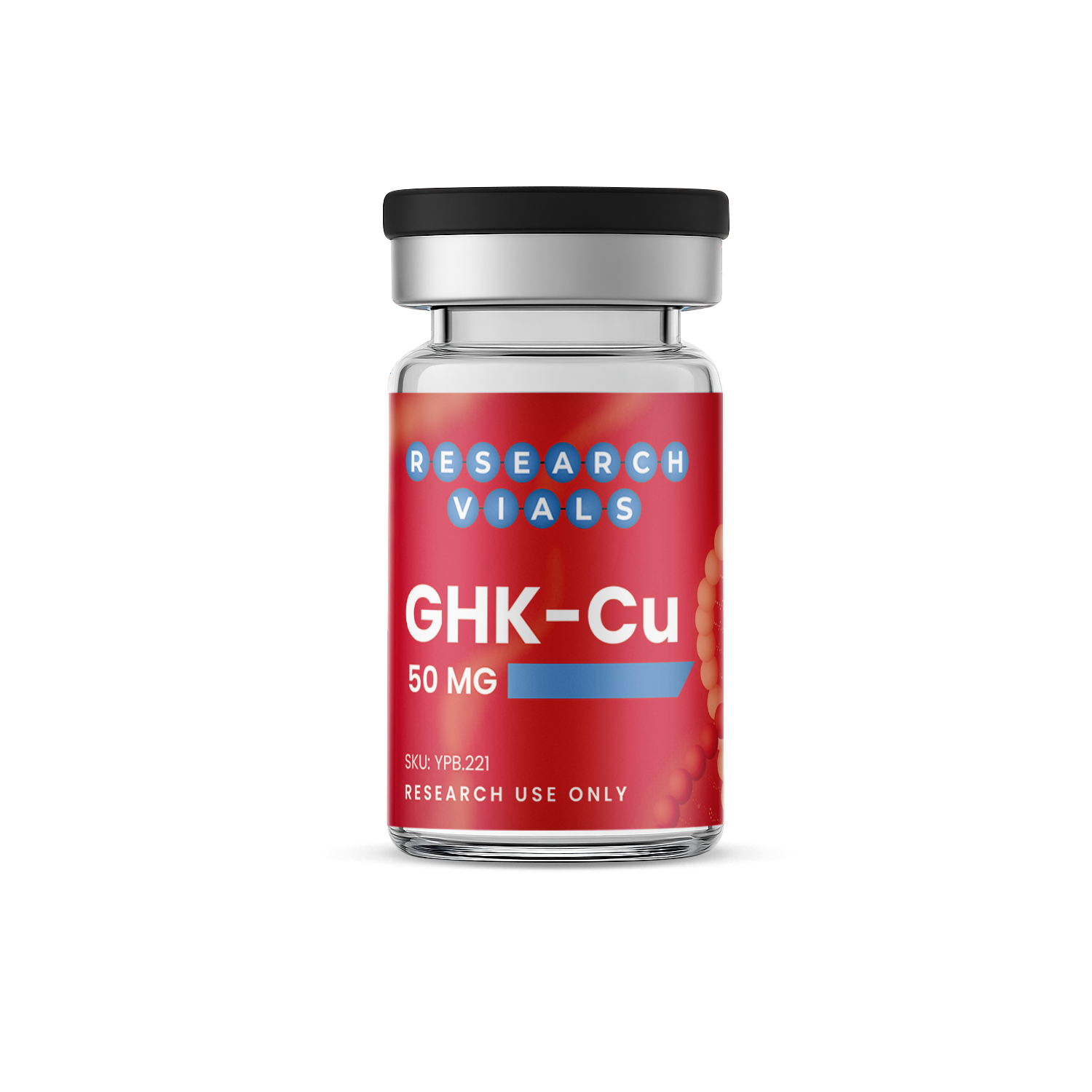
GHK-Cu has been in the literature longer than almost any other research peptide on a modern catalog. Loren Pickart isolated the GHK tripeptide from human plasma in 1973 and has spent five decades publishing on what its copper complex does in tissue-remodeling models. This page is a plain-English tour of that work, the verification process we run on each lot, and the practical handling notes that matter once a vial is on the bench.
We are a research-supply operation, not a clinical lab. Everything below is intended for licensed research use only.
What GHK-Cu actually is
GHK is a tripeptide — glycyl-L-histidyl-L-lysine — three amino acids in sequence. The “Cu” part is a copper(II) ion held in a square-planar coordination geometry by the histidine imidazole, the terminal amine, and the deprotonated peptide nitrogen. That coordination is what gives the powder its characteristic deep blue color. If a lot you receive looks pale blue or colorless, the copper loading is off and the lot should be rejected on visual inspection alone.
The molecular formula of the copper complex is C14H22CuN6O4 with a formula weight of around 402 g/mol. Compared to longer peptides we ship, GHK-Cu is small, water-soluble, and does not require refolding after lyophilization.
How we verify our GHK-Cu batches
Every lot we list is verified by an independent third-party run at Analytical Formulations, Inc. in addition to the supplier’s certificate of analysis.0% by area) and copper loading by ICP-MS or equivalent metals analysis to confirm the 1:1 stoichiometry.
A peptide that reads 99% pure but is under-coppered is not the same molecule. We have rejected one lot in the past twelve months on copper loading grounds — the peptide chain was clean, the metal was not stoichiometric. The reject did not list.
You can see current batch IDs and lab reports on the GHK-Cu product page.
Reconstitution protocol we use in-house
GHK-Cu is more sensitive to handling than the BPC and TB-500 family. Specifics:
- Bring the vial to room temperature on the bench before introducing liquid. Cold copper complexes can shed metal under thermal shock.
- Use bacteriostatic water (0.9% benzyl alcohol). Do not use saline, phosphate buffers, or anything containing chelators (citrate, EDTA, etc.) — those will pull copper off the peptide.
- Add the water down the inside wall of the vial. Swirl gently. The solution should clear to a translucent royal blue within 60 seconds.
- If the solution is faint blue, cloudy, or shows particulate, do not use the vial. Visual clarity on a copper peptide is a near-direct readout of complex integrity.
A 50 mg vial reconstituted to 5 mL gives 10 mg/mL. Mark the reconstitution date on the cap.
Stability — what we observe in our cold-chain
Copper coordination drifts faster than peptide chain integrity. Supplier guidance for reconstituted GHK-Cu is generally 14 days at 2-8°C, and that is a tighter window than you see on most peptides we list — there is a reason.By day 21 in our calibrated fridge, half the test vials show measurable color fade. We do not publish a usable window beyond 14 days for that reason. Researchers who need extended hold should aliquot and freeze at -20°C immediately after reconstitution.
Two notes from that work: avoid plastic syringes for long contact (some plasticizers will bind copper); and do not co-store with chelator-containing reagents in the same fridge — there is no chemical pathway between sealed vials, but cross-contamination during draws has been a reported source of silent purity loss.
What the published research actually says
Pickart’s review series is the entry point. The 2018 Int J Mol Sci review summarizes 45 years of work on GHK and copper-peptide tissue effects (Pickart L, Margolina A. Int J Mol Sci. 2018;19(7):1987. doi:10.3390/ijms19071987). Earlier mechanistic work on gene-expression modulation appears in Pickart L et al. Biomed Res Int. 2015 (doi:10.1155/2015/648108).
Human evidence is dominated by topical-formulation cosmetic studies. Injectable GHK-Cu in humans does not have a large randomized controlled trial we can cite. Researchers planning to extrapolate animal-model dosing to other contexts should treat that gap honestly.
Common questions from researchers
Why does the powder look different shades of blue between lots? Particle size and packing geometry change scattered-light reflection. A lot can be a slightly different shade and still be stoichiometrically correct. The reconstituted solution color is the more reliable readout.
Can we substitute saline for BAC water? For same-day use only, and not preferred. Bacteriostatic water is closer to a non-interacting matrix for copper coordination.
Is GHK-Cu the same as Copper Tripeptide-1 in cosmetic ingredients? Same molecule, different specifications. Cosmetic-grade material is not the same as research-grade material on purity, copper loading, or contaminant testing.
Can it be lyophilized again after reconstitution? Technically yes; in our experience it loses 0.5-2% peptide purity per cycle. Not recommended.
Related compounds we test
For researchers building copper-related comparisons: BPC-157 is the closest soft-tissue companion in the catalog despite operating on a completely different mechanism, and is often referenced alongside GHK-Cu in research write-ups. For multi-component formulations, our GLOW blend combines GHK-Cu with BPC-157 and TB-500 in a single vial; each component runs through the same independent verification at Analytical Formulations, Inc.