

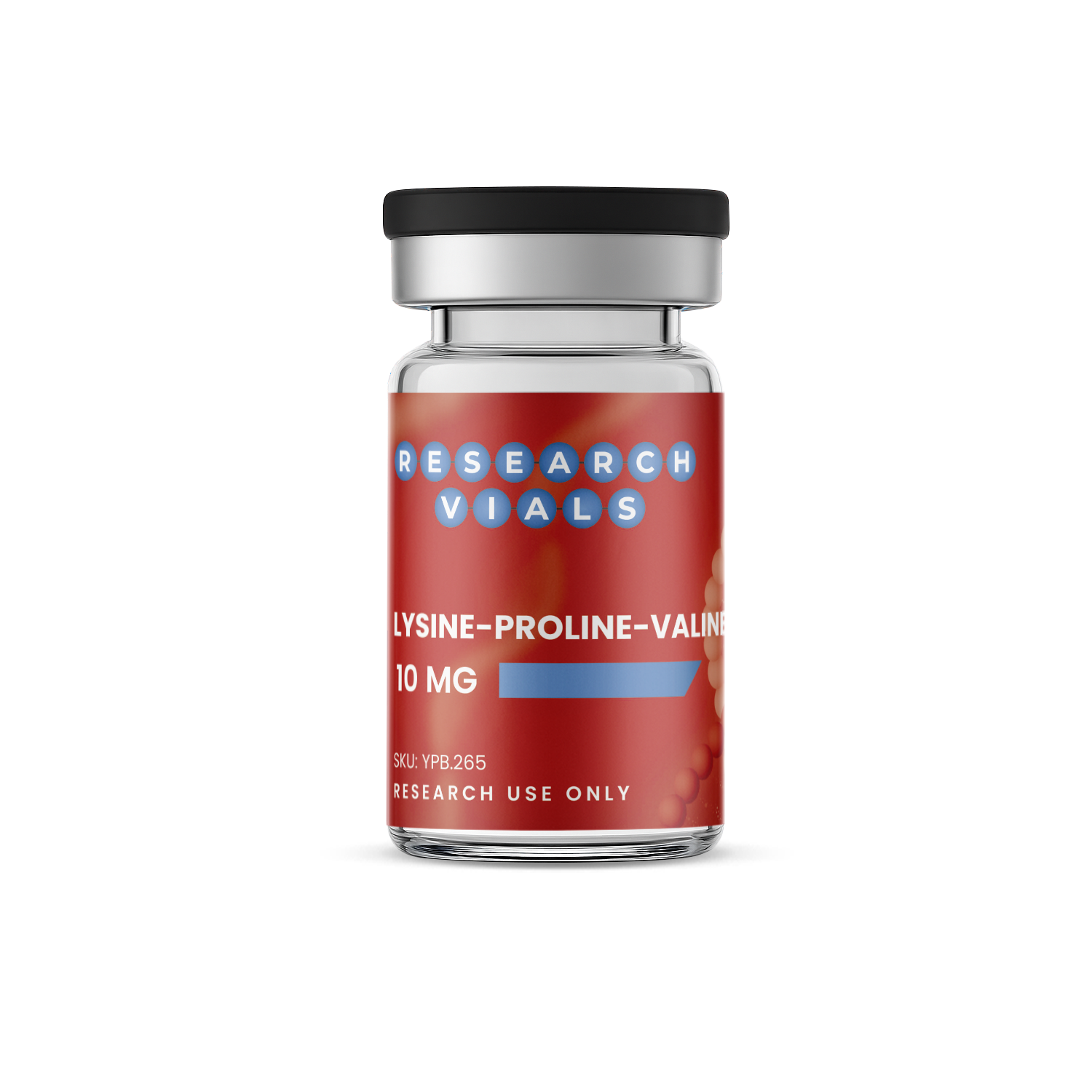
KPV is the smallest peptide in our catalog. Three amino acids: lysine, proline, valine. It’s also one of the most-researched anti-inflammatory tripeptides in the literature, because it happens to be the C-terminal fragment of α-melanocyte-stimulating hormone (α-MSH), and that fragment carries most of α-MSH’s anti-inflammatory activity without the pigmentation effects of the longer parent peptide. This page summarizes the work, the verification we run on each lot, and the practical handling notes.
We are a research-supply operation, not a clinical lab. Everything below is intended for licensed research use only.
What KPV actually is
KPV is a synthetic tripeptide with the sequence Lys-Pro-Val — the last three residues of α-MSH (residues 11-13 of the 13-amino-acid parent). Molecular weight is about 343 g/mol, which is on the small end of anything you would call a peptide; some pharmacology textbooks classify tripeptides as a separate category from “true” peptides because the activity profile and pharmacokinetics look so different from longer chains.
The lyophilized form is a white powder. Reconstituted KPV is colorless.
How we verify our KPV batches
Tripeptides are easier to make purely than longer peptides, but they are also easier to mis-identify on a chromatogram if a synthesis run produces a close-mass byproduct. We run every lot through Analytical Formulations, Inc.0% by area) and mass-spec identity confirmation against the calculated [M+H]+ of 343.2 Da. The lab report is retained on file and posted to the KPV product page.
A representative reject finding on tripeptides is residual unreacted lysine showing up as a separate peak — easy to catch on the chromatogram, easy to miss on a data-table summary that only reports the named peptide’s purity. Our acceptance threshold is on the chromatogram itself, not the summary.
Reconstitution protocol we use in-house
KPV is among the simplest peptides to handle:
- Bring the vial to room temperature for 5-10 minutes (small molecules tolerate the thermal shock better than larger ones, but we still prefer the warm-up step out of habit).
- Add bacteriostatic water (0.9% benzyl alcohol) down the wall of the vial.
- Swirl gently for 10-15 seconds. KPV dissolves on contact.
- Hold for 1-2 minutes and draw.
A 10 mg vial reconstituted to 2 mL gives 5 mg/mL. Mark the reconstitution date on the cap.
Stability — what we observe in our cold-chain
Reconstituted KPV is one of the more stable peptides we ship. Supplier guidance is 28-30 days at 2-8°C and we have not observed visual clarity issues inside that window in our calibrated fridge. The lyophilized form is stable refrigerated for the published shelf life and tolerates room temperature shipping without measurable purity loss.
We publish a 21-day usable window on the product page out of conservative defaults across the catalog. KPV could probably hold longer, but we will not vouch for vials we have not personally observed at extended hold.
What the published research actually says
The α-MSH / KPV axis has a substantial English-language literature dating back to the 1980s. The mechanism review most worth starting from is Brzoska T et al., “α-MSH and related tripeptides,” Endocrine Reviews, 2008 (doi:10.1210/er.2007-0027) — comprehensive coverage of anti-inflammatory mechanism, model systems, and the structure-activity case for KPV specifically inheriting the anti-inflammatory function of the parent.
Intestinal-inflammation work in rodent colitis models has been published in the Gastroenterology family of journals, including Dalmasso G et al., Gastroenterology. 2008 — the cited mechanism is downregulation of NF-κB signaling in epithelial cells. Skin-inflammation work has appeared across dermatology research literature.
Human evidence is dominated by topical formulation work; injectable KPV in humans does not have a large randomized controlled trial we can cite. Researchers planning to extrapolate animal-model data should treat that gap honestly.
Common questions from researchers
Is KPV the same as the GHK family? No — different parent molecules, different mechanisms, different research questions. KPV is α-MSH-derived. GHK is plasma-derived. They sometimes appear in adjacent skin-research literatures because both have been studied topically, but they are not interchangeable.
Why does the dose seem so high relative to longer peptides? Tripeptides have shorter half-lives than longer peptides because they are easier substrates for plasma peptidases. The dosing in research models reflects that — you need more of a smaller, faster-cleared molecule to maintain a given exposure.
Does the powder go bad? Lyophilized KPV is shelf-stable refrigerated. The reconstituted form is the time-sensitive state.
Does it taste like anything if dissolved in water? Lysine has a slightly sweet-bitter character; KPV solutions taste mildly bitter. Not relevant for injectable research, sometimes asked about for topical/dermal formulation development.
Related compounds we test
For researchers building anti-inflammatory comparisons: BPC-157 and TB-500 operate on different mechanisms but appear in adjacent injury/repair literatures. The KLOW blend combines KPV with GHK-Cu, BPC-157, and TB-500 for multi-component research; each component runs through the same independent verification at Analytical Formulations, Inc.