

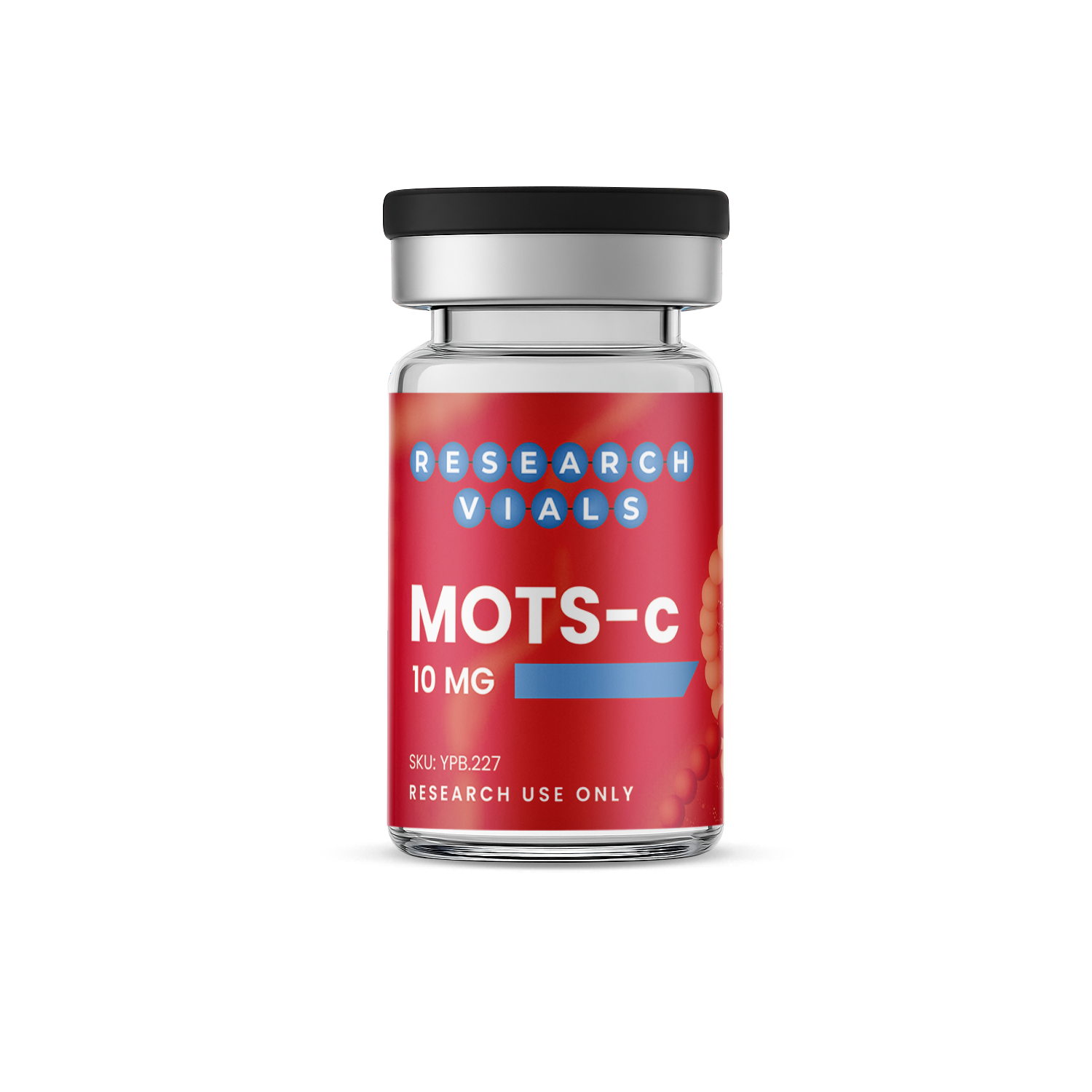
MOTS-c was the discovery that mitochondria are not just power plants. Until 2015, the standard textbook account had it that mitochondrial DNA encoded 13 protein-coding genes, all of them components of the electron transport chain. Then Changhan Lee and Pinchas Cohen’s lab at USC published a paper in Cell Metabolism describing a 16-amino-acid peptide encoded by the mitochondrial 12S rRNA gene, secreted into circulation, and acting as a regulator of metabolic homeostasis. That peptide is MOTS-c, and the discovery reframed mitochondria as endocrine organs. This page summarizes the work, the verification we run on each lot, and the practical handling notes.
We are a research-supply operation, not a clinical lab. Everything below is intended for licensed research use only.
What MOTS-c actually is
MOTS-c stands for “Mitochondrial Open Reading frame of the Twelve S rRNA type-c.” It is a 16-amino-acid peptide with the sequence Met-Arg-Trp-Gln-Glu-Met-Gly-Tyr-Ile-Phe-Tyr-Pro-Arg-Lys-Leu-Arg. The unusual feature is its origin: the gene is located inside the mitochondrial 12S rRNA, which until MOTS-c was thought to code only for ribosomal RNA. The discovery suggested that mitochondrial DNA carries small open reading frames whose products act as endocrine signals.
Molecular weight is about 2,174 g/mol. The lyophilized form is a white-to-off-white powder; reconstituted MOTS-c is colorless.
How we verify our MOTS-c batches
MOTS-c is challenging to synthesize cleanly because of the two adjacent methionines and the multiple aromatic residues. We run every lot through Analytical Formulations, Inc.0% by area) and mass-spec identity confirmation against the calculated [M+H]+ of 2,175 Da. The lab report stays on file and is posted to the MOTS-c product page.
The most common synthesis-related reject finding is methionine oxidation, which shifts the mass by +16 Da per oxidation event. A lot with 1-2% sulfoxide on the chromatogram does not meet our acceptance threshold even if the supplier’s COA reports the parent peptide as ≥98%. We have rejected one lot in the past nine months on this profile.
Reconstitution protocol we use in-house
MOTS-c is moderately straightforward to handle but the methionines deserve some attention:
- Bring the vial to room temperature for 15-20 minutes.
- Use bacteriostatic water (0.9% benzyl alcohol). Avoid any matrix that contains oxidants (peroxides, hypochlorite contamination from improper storage).
- Add water down the wall of the vial. Swirl gently for 30-45 seconds.
- Hold for 5 minutes before drawing.
A 10 mg vial reconstituted to 2 mL gives 5 mg/mL. Mark the reconstitution date on the cap. Cap immediately after each draw — atmospheric oxygen contact is the main pathway for slow methionine oxidation in the reconstituted state.
Stability — what we observe in our cold-chain
Reconstituted MOTS-c holds for 21 days at 2-8°C when the cap is sealed promptly after each draw. Repeated headspace-air exposure shortens the usable window meaningfully because of the methionine sensitivity described above. We have observed measurable purity loss at day 14 on a vial whose cap was loose during routine drawer access — that vial was discarded.
We publish a 21-day usable window on the product page assuming proper recapping. For research designs that need extended hold, aliquot to single-use volumes and freeze at -20°C; the lyophilized form is the most stable state and is what the published shelf life is anchored to.
What the published research actually says
The original discovery paper is Lee C et al., “The mitochondrial-derived peptide MOTS-c promotes metabolic homeostasis and reduces obesity and insulin resistance,” Cell Metabolism. 2015;21(3):443-54 (doi:10.1016/j.cmet.2015.02.009). That paper established mechanism (AMPK activation, glucose-uptake effects in skeletal muscle) and animal-model phenotype (resistance to diet-induced obesity).
Follow-up work from the same lab and others has examined MOTS-c in exercise-response models, age-related metabolic decline, and cardiac-protection contexts. Reichert and colleagues have published on related mitochondrial-derived peptides (humanin, SHLP family) that suggest MOTS-c is one member of a broader peptide class encoded in mitochondrial DNA.
Human clinical evidence remains preliminary. There is no large randomized controlled trial we can cite. The mechanism literature is robust; the outcome literature is early. Researchers should treat those as separate certainties.
Common questions from researchers
Why is MOTS-c described as “exercise-mimetic”? Because some of the metabolic phenotypes observed in MOTS-c-treated rodent models — improved glucose handling, AMPK activation in muscle — overlap with what exercise produces. The phrasing is descriptive of phenotype, not a mechanistic identity claim.
Is MOTS-c the same as Humanin? No. Both are mitochondrial-derived peptides discovered by the Cohen lab and adjacent groups, but they have different sequences, different lengths, and different downstream pharmacology. Humanin (24 aa) was characterized first; MOTS-c is the second well-characterized member of the family.
Does the peptide need to be protected from light? Tryptophan and the aromatics make MOTS-c modestly photosensitive. The amber-glass vials are deliberate. Avoid extended bench exposure to direct sunlight.
Storage in the lyophilized form — refrigerated or frozen? Refrigerated short term, frozen long term. The lyophilized cake is the most stable state.
Related compounds we test
For researchers in the mitochondrial-axis literature: SS-31 is the natural companion in mechanism — engineered from outside to target the inner mitochondrial membrane, where MOTS-c originates from inside. For broader cellular-energy work, NAD+ precursors sit in an adjacent mechanism. Each runs through the same independent verification at Analytical Formulations, Inc.